Faster Isn’t Always Better: Building a Customer-Forward E-Commerce Parcel Network by Joe Wilkinson
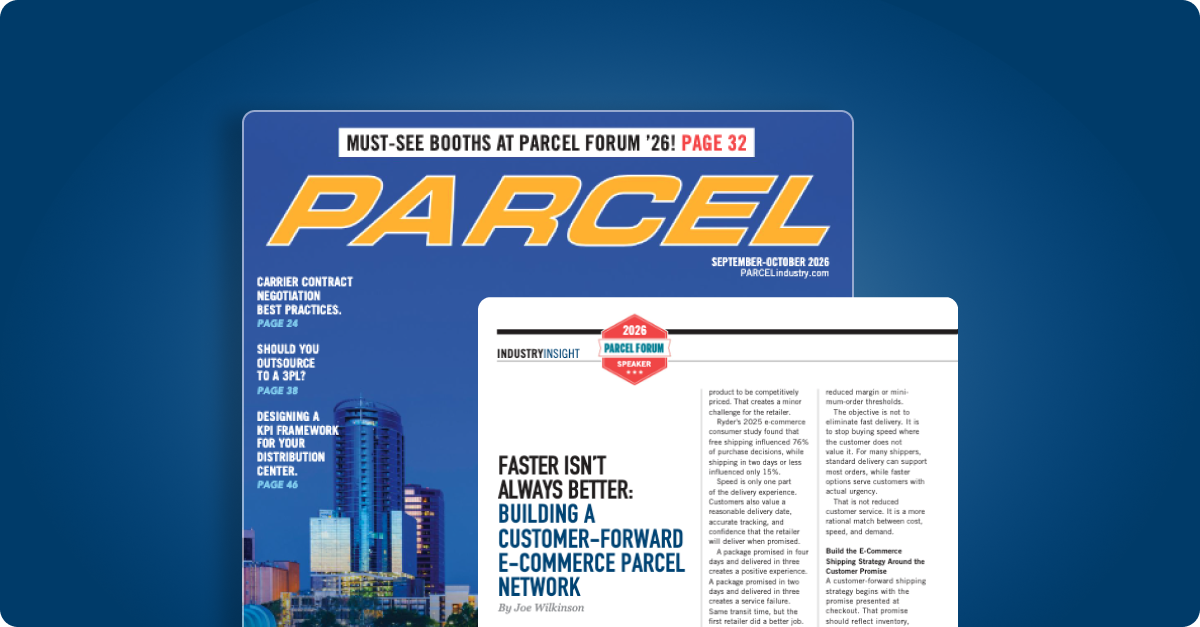

Originally published in the September/October 2026 issue of PARCEL Magazine on page 14, this article features insights from Joe Wilkinson, VP of Professional Services at Intelligent Audit, on how shippers can balance cost, service, and customer expectations when building an e-commerce parcel network.
For nearly two decades, e-commerce delivery strategy has followed a simple assumption: faster is better. Two-day delivery became next-day delivery. Next-day became same-day delivery. Presumably, the ultimate objective is to deliver the package before the customer realizes they need it.
Speed matters. Some purchases are urgent, and customers will pay for convenience. But every order does not need to move through the network as though it contains a replacement organ.
A customer-forward parcel network is not necessarily the one that delivers every package as quickly as possible. It is the one that makes the right promise and keeps it consistently.
What Customers Want From the E-Commerce Delivery Experience
Customers want delivery to be fast, free, reliable, visible, flexible, and convenient. Unfortunately, they also expect the product to remain competitively priced. That creates a minor challenge for the retailer. Ryder’s 2025 e-commerce consumer study found that free shipping influenced 76% of purchase decisions, while shipping in two days or less influenced only 15%.

Speed is only one part of the delivery experience. Customers also value a reasonable delivery date, accurate tracking, and confidence that the retailer will deliver when promised.
A package promised in four days and delivered in three creates a positive experience. A package promised in two days and delivered in three creates a service failure. The transit time is the same, but the first retailer did a better job.
Why Faster E-Commerce Delivery Increases Parcel Shipping Costs
There is no mystery behind the cost of speed. Shorter commitments reduce the fulfillment locations, carriers, and services available. They can encourage air upgrades, expensive recovery decisions, and network designs built around demanding orders that represent little volume. Then there is free shipping. Customers like it, and retailers often need to offer it. Carriers, however, remain curiously unwilling to participate in the “free” portion of the arrangement. Someone still pays, usually through reduced margins or minimum-order thresholds.
The objective is not to eliminate fast delivery. It is to stop buying speed where the customer does not value it. For many shippers, standard delivery can support most orders, while faster options serve customers with actual urgency. That does not reduce customer service. It creates a more rational match between cost, speed, and demand.
Build the E-Commerce Shipping Strategy Around the Customer Promise
A customer-forward shipping strategy begins with the promise presented at checkout. That promise should reflect inventory, processing, carrier pickups, expected transit, geography, and risk. It should not reflect the most optimistic interpretation of a carrier’s service map. Shippers should offer a few understandable choices, such as economical standard delivery, a faster paid option, and pickup or scheduled delivery. Customers should know when the order is expected, what each option costs, and whether paying more creates a meaningful improvement.
Presenting customers with seven services and unfamiliar acronyms is not personalization. It makes the customer do the work. Checkout options are only as good as the network behind them. Inventory placement, ship-from location, warehouse processing, pickup schedules, and routing logic all affect the result. A ground shipment originating near the customer may arrive sooner and cost less than an air shipment moving across the country.
Routing technology should select the lowest-cost service capable of meeting the delivery date. It should use actual transit performance rather than published standards. Pure rate shopping without performance data is a very efficient way to make poor decisions.
A parcel negotiation cannot compensate for inventory in the wrong locations, late processing, poor packaging, or routing rules that habitually upgrade shipments. Decisions made before rating the package often matter as much as carrier pricing.
Use a Multi-Carrier Shipping Strategy Without Creating Carrier Chaos
Carrier diversification can improve cost, service, resilience, capacity, and negotiating leverage. But the objective is not to accumulate carrier logos. Each carrier should have a defined role. National carriers may support broad coverage and difficult shipments. Regional, technology-forward, and postal carriers may offer better transit or economics in specific markets. Other providers may serve as tested contingency options.
The word “tested” is important. Awarding a carrier 1% of the network, never evaluating its ability to scale, and then calling it a backup is not diversification. It is theater. Shippers can also diversify too far. Splitting volume among too many carriers can reduce density, weaken negotiating leverage, complicate operations, and make accountability difficult. The goal is not more carriers. It is the right carriers for the right shipment segments.
Negotiate Parcel Contracts Around Cost and Customer Experience
Parcel contract negotiation is generally treated as a pricing exercise. That is understandable. Every dollar a shipper saves is a dollar the carrier does not collect. This may explain why carriers rarely volunteer their best pricing out of a sense of community responsibility. But a customer-forward agreement must support more than a low theoretical rate. It should reflect the shipper’s package profile, accessorials, dimensional weight, minimum charges, fuel, rate caps, peak pricing, capacity, and flexibility to reallocate volume.
A large discount applied to the wrong rate or service does not create a strong agreement. Neither does attractive pricing that directs volume to a poorly performing carrier. The agreement and pricing should support the network strategy. The network strategy should support the customer promise. Reversing that order allows carrier pricing to dictate the customer experience.
Measure E-Commerce Delivery Performance Against the Promise
Shippers should measure what the customer experiences, not merely what the carrier reports. Carrier-reported on-time performance is useful, but insufficient. Shippers should measure performance against the date communicated to the customer. They should then segment the results by carrier, service, origin, geography, facility, and shipment type.
A customer-forward scorecard should include delivery against the promise, actual transit time, first-attempt success, exceptions and resolution time, tracking accuracy, damage and claims, and cost per successfully delivered package. National averages can hide significant problems. A carrier may perform well overall while failing in a specific market, lane, or service. Averages have a wonderful ability to make localized disasters look respectable. A customer whose package arrives late does not care that the broader network was 97% on time.
The Best E-Commerce Parcel Network Keeps the Right Promise
Building a customer-forward e-commerce parcel network is not a choice between service and cost containment. Shippers can control unnecessary speed, offer meaningful choices, use the right carriers, negotiate agreements that support the network, and measure performance against the customer promise.
The fastest delivery will sometimes be the right delivery. Often, it will not. The best parcel network is not the one that promises the fastest transit. It is the one that makes the right promise, keeps it consistently, and does so at a sustainable cost.
Subscribe for more content!
Stay ahead of the curve in supply chain and logistics technology. Get practical insights on AI-driven automation, real-time visibility, and the tools reshaping how goods move—delivered straight to your inbox.