The Algorithmic Reinvention of Parcel Logistics by Tammy Tippins
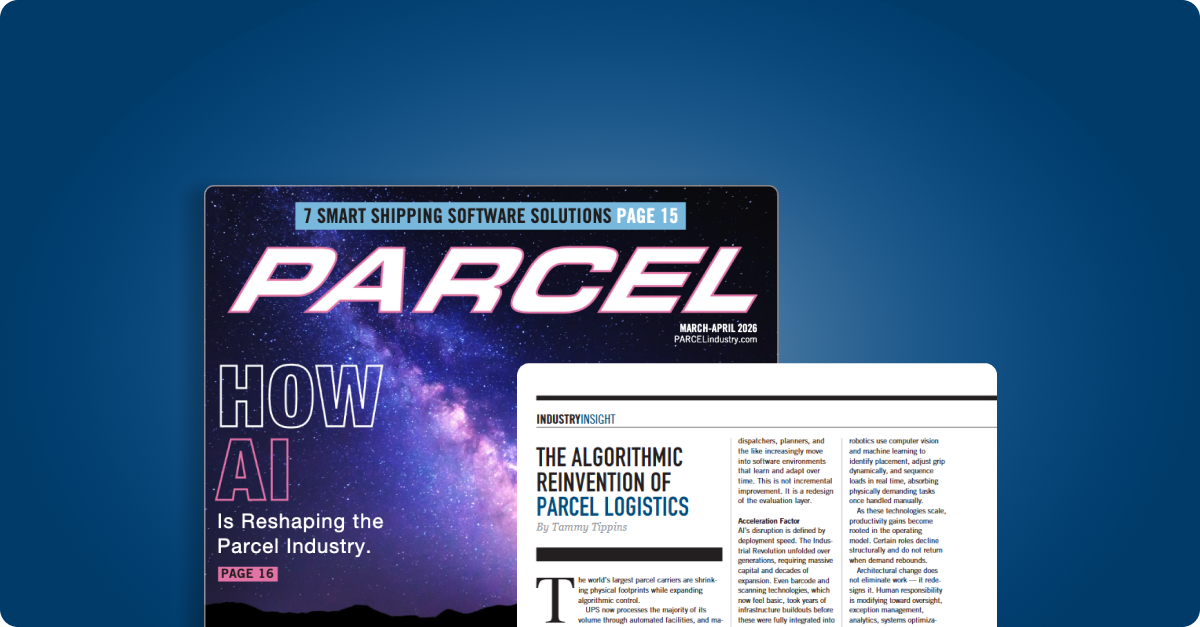

Originally published in the March/April 2026 issue of PARCEL Magazine, this article features insights from Tammy Tippins, Director of Professional Services at Intelligent Audit, on how AI is transforming the parcel industry and reshaping operational strategy across modern logistics networks.
For decades, competitive advantage in parcel logistics meant larger fleets, more hubs, and denser routes. Today, it increasingly means better models, faster data cycles, and smarter systems. The industry was built on a physical scale and is now being rebuilt on algorithmic control. The introduction of steam power replaced horse-drawn transport and made long-haul movement commercially viable. Railroads stitched regions together and pushed commerce across borders. Internal combustion engines expanded distribution nationwide. Cargo aircraft made overnight international delivery possible. Containerization quietly rewired global trade. Even when digital systems entered the picture, they largely enhanced visibility and recordkeeping.
But operators still made critical decisions. Artificial Intelligence shifts that authority. For the first time in modern history, the parcel industry is not just automating labor, it is mechanizing decision-making itself. From route optimization to network design, from labor forecasting to revenue auditing, AI systems are beginning to replace individual judgment and labor at scale. The speed of this transformation is unlike anything the industry has experienced.
Physical Scale to Algorithmic Control
Earlier waves of innovation in logistics largely expanded what people could do. Workers became more efficient while networks became larger. Output grew and what didn’t change was who made the operational calls. AI introduces a different shift. It doesn’t just enhance performance - it begins to absorb the judgment behind it.
Today, machine learning systems can forecast shipping volumes down to specific postal codes, adjust delivery routes in real time based on traffic and population density, estimate trailer utilization before loading begins, flag billing discrepancies automatically, project labor needs by shift, and surface network bottlenecks before they ripple outward.
Independently, none of these capabilities seem radical. Collectively, they change the structure of how decisions are made. Tasks that once required analysts, dispatchers, planners, and the like increasingly move into software environments that learn and adapt over time. More than incremental improvements, it is an overhaul of the decision layer itself.
Acceleration Factor
AI’s disruption isn’t defined solely by what it can do. It’s defining itself by how quickly it can be adapted and embedded. If we look at the Industrial Revolution, it unfolded over generations where rail networks required massive capital investment and decades of expansion. Even barcode and scanning technologies, which now feel basic, took years of infrastructure build outs before these were fully integrated into parcel operations.
AI moves at a fundamentally different speed. Platforms can be deployed across large portions of a network in months, sometimes less, rather than years. Cloud design allows rapid scaling without the need for physical expansion. Unlike mechanical systems, algorithms improve as they process more data, often without visible changes to the infrastructure around them. Over time that velocity compounds. A one-percent improvement in network efficiency may sound marginal in isolation. Applied across billions of annual parcels, however, it can translate into hundreds of millions of dollars in value. Since AI systems influence routing, labor forecasting, density optimization, and billing simultaneously, the gains rarely remain confined to a single node.
The acceleration is not merely operational, it is systemic.
Workforce Inflection Point
The impact of AI is no longer theoretical.
UPS has announced significant workforce reductions recently as part of a broader network overhaul. In 2018, UPS increased investments in automation that accelerated where they are now. By 2019, roughly 80% of UPS packages were processed through automated facilities, a rapid redesign of operational architecture. By 2023, the company had tested and deployed robotic systems capable of unloading trailers and automating warehouse processing, with plans to expand those deployments rapidly.
These systems are not limited to sorting lines. AI-guided robotics now operates on loading docks, using computer vision and machine learning to identify package placement, adjust grip dynamically, and sequence loads in real time. Physically demanding, repetitive, and injury prone manual labor tasks are increasingly being absorbed by autonomous systems.
FedEx, the U.S. Postal Service, and DHL are pursuing similar structural strategies, integrating networks, deploying robotics, applying predictive analytics, and consolidating operations. Individually, these efforts are framed as efficiency initiatives. Collectively, they represent an organizational evolution of the logistics industry.
Historically, workforce reductions in logistics were cyclical, tied to economic downturns, seasonal volume shifts, or temporary demand compression. Today’s shift is different, it is architectural. As intelligent systems scale across networks, labor demand in certain operational categories declines. Manual sorting, dispatch coordination, invoice auditing, loading and unloading, and elements of network planning are increasingly managed by AI-driven platforms rather than human teams. When advanced technologies absorb a function, productivity gain becomes rooted in the operating model. Those roles do not simply return when demand rebounds. But architectural change does not eliminate work, it redesigns it. Human roles are moving toward oversight, exception management, systems optimization, analytics, customer strategy, and advanced operations design. The center of gravity is shifting from physical output alone to digital fluency, systems integration, and adaptive decision-making.
For employees whose careers were built inside traditional facilities, this moment represents more than modernization, it is a pivotal transition. It requires agility, continuous learning, and the intentional creation of new career pathways aligned with a technology-enabled operating model. The organizations that will lead in this next era will not be those that digitize the fastest, but those that modernize both their infrastructure and their workforce in parallel.
Intelligent technologies can increase efficiency, improve safety and unlock new levels of precision and scale. But sustainable advantage comes from pairing technological investment with meaningful workforce development. Technology may redefine the process, but how we invest in people will define the industry’s future.
AI-Native Disruptors
While legacy carriers are modernizing networks that were built decades ago, a newer class of logistics companies started from a different premise entirely.
Amazon, for instance, didn’t just automate fulfillment centers, it designed an ecosystem where data drives nearly every operational layer. In real time, inventory positioning, delivery sequencing, labor planning, even capacity forecasting are continuously recalculated. The trucks and facilities are physical, but the coordination behind them is software-led. Next came the gig-oriented delivery platforms. Companies like DoorDash, Veho, Jitsu, and other hybrid last-mile providers approach delivery as a real-time optimization engine. Instead of fixed dispatch boards or rigid territories, their networks are fluid. Drivers log in and out as capacity flexes, while routing logic recalibrates continuously based on density, demand, and geography.
Operations and technology are intertwined in these models. In many ways, these companies were practicing AI-enabled logistics before much of the traditional industry visibly framed it that way. Decision-making was implanted in code from the beginning.
For established carriers, AI represents a transition whereas the digital-native players, it’s the operating foundation. Progressively changing the competitive advantage in parcel logistics is now shaped less by physical scale and more by the sophistication of the systems directing that scale.
Efficiency and Exposure
There is a quieter tension enclosed in this shift. As parcel networks become more intelligent, they also become more dependent on digital continuity.
Gig networks cannot function without continuous connectivity. Routing decisions, forecasting models, and automated sortation systems are all entrenched in tightly integrated data ecosystems. The judgment that once lived in distributed facilities now sits inside centralized cloud platforms. The result is remarkable efficiency, and a level of universal exposure the industry has never had to manage before.
A significant cyber event, extended cloud outage, or widespread systems disruption would not only slow physical movement, but it could also interrupt the decision layer that coordinates the entire network. In highly automated environments, reverting back to manual processes is not always straightforward. Earlier logistics systems were labor-intensive and, in some ways, inefficient. But they were also decentralized in their judgment. If one node struggled, experienced operators could often compensate locally. In AI-driven networks, intelligence is more unified - as efficiency increases so does systemic dependency. That is the tradeoff at the center of cognitive automation.
New Operating Reality
The parcel sector is moving into an era defined by algorithmic control. Organizations that embed AI effectively into their operating models will gain structural advantages in cost, speed, and predictability. Those that fail to adapt risk long-term competitive erosion.
AI is no longer experimental. It is foundational. The strategic challenge now lies in managing the human, operational, and systemic implications of that shift. The industry is not layering technology onto an existing model. It is replacing the model.
Subscribe for more content!
Stay ahead of the curve in supply chain and logistics technology. Get practical insights on AI-driven automation, real-time visibility, and the tools reshaping how goods move—delivered straight to your inbox.