Conversations at Gartner®: How to Leverage AI in Real Ways Right Now - Hannah Testani on SupplyChainBrain


Last month at Gartner, Hannah Testani sat down with Robert Bowman of SupplyChainBrain to discuss one of the most talked-about topics in business today: AI.
The conversation focused on a question many organizations are still trying to answer: How do you move beyond the hype and start creating real value with AI?
For Hannah, the answer starts with changing how we think about it.
Watch the full interview:
Start with Automation
"When I think about AI, I always break it up into two worlds," Hannah explains. "One is automation, which is actually easier for most companies if you stop using the word AI and just say automation."
It's a practical perspective that cuts through much of the noise surrounding AI adoption today. While organizations continue to explore what's possible, many of the most immediate opportunities are simply about making existing processes more efficient.
"We've been doing that for 100 years," Hannah says. "That is one of the easiest ways to accomplish and weave AI through your organization."
Think Smaller to Move Faster
One of the biggest mistakes Hannah sees is organizations trying to solve everything at once.
"What it feels like, especially at Gartner, is last year everyone spent so much money thinking about these massive orchestrations and how to use AI to do this end-to-end lifecycle fully automated," she says. "We're not there yet."
Instead, Hannah encourages companies to focus on incremental progress.
"My suggestion is start smaller. Create incremental wins for each team. That way you get winners across every department, and then you can start to use them to teach each other and get actual wins."
This approach not only reduces risk but also helps organizations build confidence, prove value, and accelerate adoption across the business.
Look for Repetitive Work
For companies wondering where to start, Hannah points to highly repeatable tasks.
"From a productivity perspective, you could be using it to automate any job where it is highly repeatable," she says. "If it's every time this happens, do this, or do X, Y, and Z."
In other words, if a process already follows a defined set of rules, it may be an ideal candidate for AI-powered automation.
"If there's an SOP, there's a great place to use AI."
It's a simple framework, but one that can help organizations identify immediate opportunities to improve productivity, reduce manual effort, and free teams to focus on higher-value work.
Moving Beyond the Hype
Organizations don't need massive transformation projects to benefit from AI. They need clear objectives, quality data, and a practical strategy.
That's the central message of Hannah's conversation with SupplyChainBrain. The companies seeing success today are the ones applying AI to real operational challenges and measuring the outcomes.
At Intelligent Audit, that approach has been in practice for years.
"We've been leveraging AI for about eight years now as an organization, before it was this sexy buzzword," Hannah says.
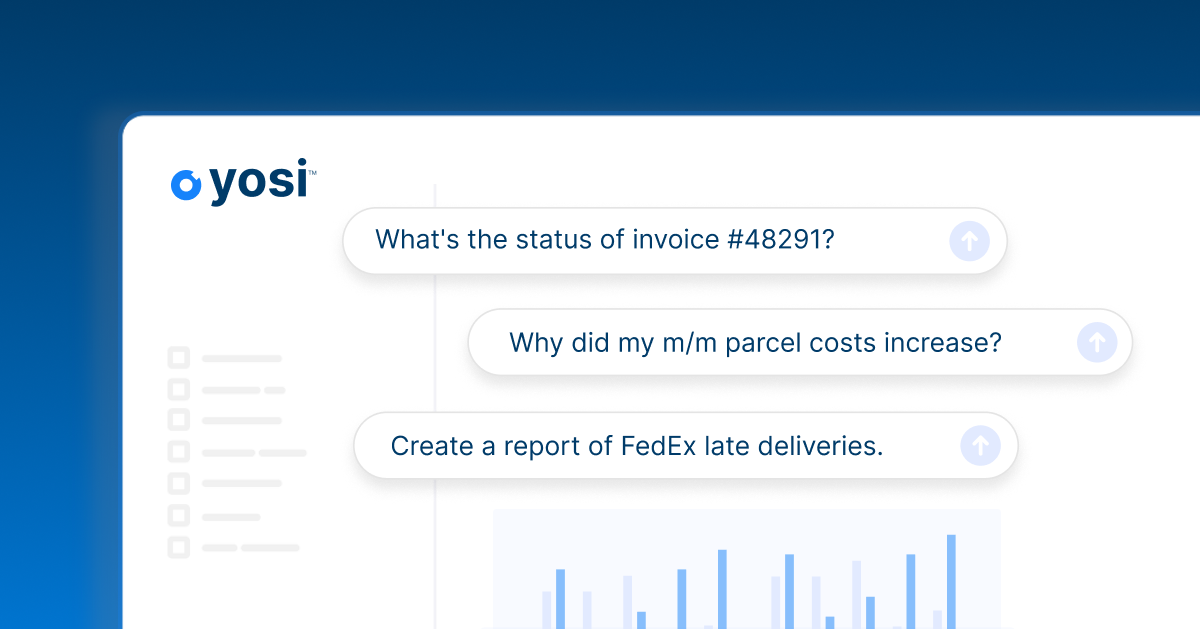
One example is anomaly detection. Similar to how credit card companies learn spending patterns and flag suspicious activity, Intelligent Audit's DeepDetectAI™ learns shipping behaviors across a customer's network and identifies activity that falls outside the norm.
"If it could not predict the shipment, it's atypical, what we call an anomaly," Hannah explains.
Those anomalies can reveal fraud, carrier selection issues, integration failures, and other operational problems before they become larger, more costly issues.
"Usually these are very micro issues that will have a macro impact eventually," she says. "Fraud doesn't grow linearly. It grows exponentially."
By identifying those exceptions early, Intelligent Audit helps customers turn transportation data into actionable insights that reduce risk, protect spend, and improve performance.
If you're looking for a straightforward discussion on how AI in logistics is creating value for organizations right now, this interview is worth watching on supplychainbrain.com.
Subscribe for more content!
Stay ahead of the curve in supply chain and logistics technology. Get practical insights on AI-driven automation, real-time visibility, and the tools reshaping how goods move—delivered straight to your inbox.