
How can supply chain, logistics, and transportation leaders turn AI initiatives into measurable business value?
That is the question our CEO Hannah Testani and Florian Selch of the Masters of Supply Chain sought to answer in this four-part Supply Chain AI Playbook interview series.
Together they explore how connected data, domain expertise, strong governance, and focused experimentation can turn AI into measurable business value.
Across four conversations, one practical message stands out. Think bigger about what AI can make possible. Then start small enough to prove it. Watch the series to hear what leaders are learning and where they are placing their bets.
Start with the problem
AI is easier to prioritize when leaders give it two clear jobs: innovation and productivity.
- Innovation. Use AI to find patterns, risks, and opportunities that people cannot evaluate at scale. In transportation, that can mean learning what normal activity looks like across millions of records and surfacing unusual cost or service behavior. As Hannah explains it:
“Where AI shines is it can take millions of data points at any given time, and it can find those anomalous patterns. Without any kind of human intelligence saying, ‘Tell me when this happens,’ it’s saying, ‘I’m going to consume all this data, and when something happens that I couldn’t predict, I’m making you aware of it.’”
- Productivity. Use AI to reduce repeatable work. Teams can review contracts, test rules, analyze data, or prepare code faster while experts remain responsible for the final judgment.
This distinction keeps teams focused. Instead of launching a broad AI initiative, they can name the outcome they need and choose the right approach for that job.
Data still needs context
Supply chain data rarely arrives clean and consistent. It lives across carriers, modes, systems, acquisitions, and business units. Even basic measures can vary. One system may count items, another pallets, and another shipments.
AI can help map records, identify exceptions, and test likely connections. However, it cannot decide what the data means for the business without context. Domain experts still need to define the rules and validate the results.
Before a pilot begins, teams should answer four questions:
- Ownership. Who is responsible for the data and its quality?
- Definitions. Do teams use the same language, units, and business rules?
- Access. What can the AI read, and what should remain restricted?
- Outcome. Which cost, service, risk, or productivity result will define success?
Start small
Large AI programs can spend months in integration work and risk reviews before they produce a useful answer. Focused pilots create evidence faster. They also make it easier to correct assumptions before the stakes grow.
Choose one real problem. Connect only the data needed to answer the first question. Set a measurable outcome. Then place business experts close to the work so they can test the output and explain why it is right or wrong.
Visible wins build confidence. When employees see a team solve a meaningful problem in days or weeks, the conversation changes. AI becomes a practical tool, not an abstract transformation project. This is well illustrated by Hannah, when she advises:
“Dream big. Have a vision of where you want to get to, but start incredibly small. Connect two systems together, and then have a unique problem you want to solve. You really need to have experts guiding it and doing a lot of iterative testing. Don’t try to create this massive project where you can’t see a win quickly.”
AI changes the work
AI does more than speed up individual tasks. It changes where work gets stuck. Faster development creates little value if product feedback, security review, or business validation cannot keep pace.
At Intelligent Audit, faster engineering cycles brought product expertise closer to development. The goal was not simply to produce more code. It was to shorten the distance between a customer problem, a working solution, and useful feedback.
Strong AI programs bring several perspectives together:
- Business and domain experts. Define the problem and judge whether the answer makes sense.
- Product, engineering, and data teams. Build, test, and improve the solution.
- Security and governance leaders. Set access rules, controls, and approval points.
- People leaders. Help employees understand how their roles and skills will evolve.
Hannah sees the biggest shift not in replacing people, but in moving their time toward higher-value work:
“Anything highly repetitive and manual that you can teach and outline in a Word document or video is the kind of work that gets replaced. But when you need to use your brain, think, and collaborate, those are the jobs that will be supercharged.”
Put guardrails in place
AI systems try to complete the task they receive. That can create risk when a helpful response changes data, workflows, or historical records that should remain protected.
A safer path is to expand access in stages:
- Begin with read access. Let AI retrieve, compare, and recommend before it can change anything.
- Keep approval points clear. Require human review for financial, operational, customer, and historical data changes.
- Protect systems of record. Use AI to strengthen proven platforms rather than replace critical controls too quickly.
- Monitor the results. Track accuracy, exceptions, user behavior, and business impact as the use case expands.
As Hannah explains, those safeguards should be built in from the start, especially when AI interacts with sensitive or historical data:
“You have to create very good guardrails. I would start with just read access. Don’t do any kind of writing. If you have a database, give the team the ability to extract information, but create multiple protections so they can’t write anything, because AI aims to please. If you say, ‘Could you fix it?’ then it will try to fix historical data where you might not want it to.”
Domain expertise will separate the winners
AI has made software easier to build. It has not made supply chain expertise easier to copy. The hardest transportation questions still depend on contracts, carrier behavior, service tradeoffs, operational exceptions, and years of institutional knowledge.
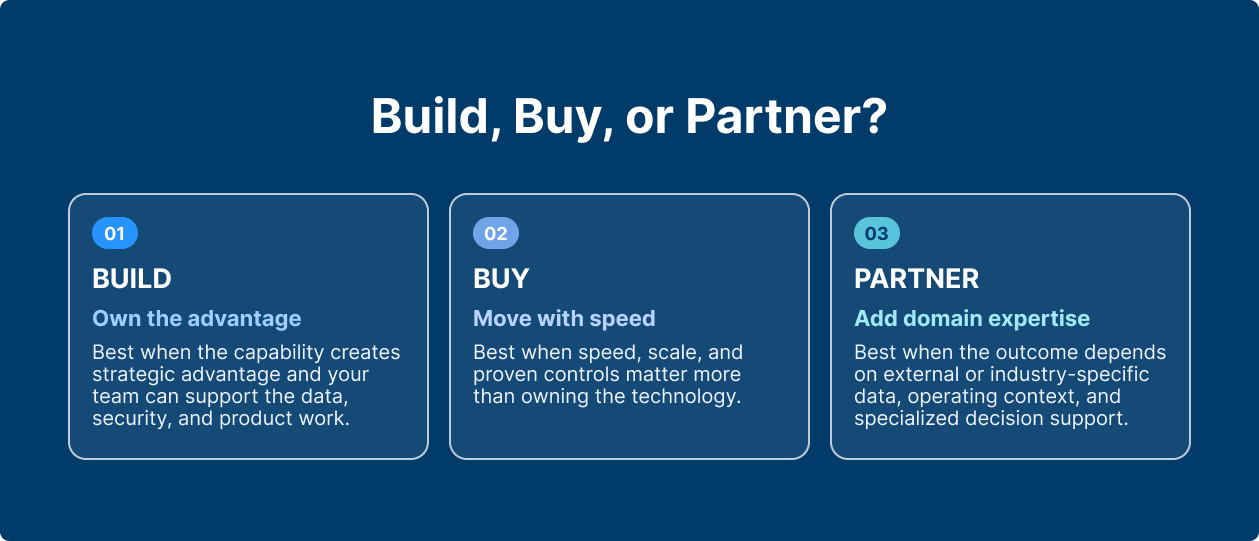
That should guide the build, buy, or partner decision. Start with the outcome and the expertise required to reach it.
- Build. Choose this path when the capability creates a true strategic advantage and the organization can support the data, security, and product work behind it.
- Buy. Use a proven solution when speed, scale, and established controls matter more than owning the technology.
- Partner. Work with experts who already understand the data, operating environment, and decisions the technology needs to support.
The AI playbook
1. Define the outcome. Name the cost, service, risk, or productivity problem first.
2. Map the minimum data. Identify the few sources needed to answer the first question.
3. Choose a contained pilot. Select a meaningful use case that can show results quickly.
4. Start with read access. Let AI analyze and recommend before it can take action.
5. Keep experts close. Pair the technology with business, product, data, and security judgment.
6. Measure the value. Track accuracy, adoption, cost, speed, decision quality, and customer impact.
7. Scale what works. Document the guardrails, share the win, and expand one use case at a time.
A strong AI strategy does not ask an organization to become a different company. It helps the company deliver its existing value with more speed, reach, and precision.
For supply chain leaders, the path is clear. Start with a real problem. Connect the right data. Keep experts in the loop. Protect the decisions that matter. Prove the value, then scale what works.
Watch the four-part series
Hear Hannah Testani and Florian Selch explore the foundations, operating models, technology choices, and leadership decisions shaping practical AI adoption in supply chain.
Subscribe for more content!
Stay ahead of the curve in supply chain and logistics technology. Get practical insights on AI-driven automation, real-time visibility, and the tools reshaping how goods move—delivered straight to your inbox.