Top AI Use Cases in Logistics: 22 Real-World Examples

AI in logistics works best when it solves a clear operational problem. It can help a team choose a better route, predict a late delivery, rebalance inventory, catch an unusual charge, or answer a routine question faster.
The use cases below show what that looks like across the logistics lifecycle. Each example distills a real application into the problem, the role of AI, and the operational result. Together, they show where AI is already creating value and what logistics leaders should look for in their own networks.
Smarter delivery
1. Improve delivery-location accuracy
A correct street address does not always lead a driver to the right door. Large campuses, apartment complexes, rural properties, and new developments can all create costly last-mile errors.
AI can combine past delivery scans, driver corrections, map data, customer instructions, and geospatial signals to predict the best drop-off point. It can also learn when a location needs a gate code, loading-dock entrance, or building-level instruction.
This reduces failed attempts and unnecessary driver time. It also improves the customer experience without forcing dispatchers to review every address by hand.
2. Adapt routes in real time
A route that looked efficient at 7 a.m. may stop working by 10 a.m. Traffic changes. Orders arrive late. Delivery windows move. A vehicle may lose capacity.
AI-driven routing can recalculate the plan as conditions change. It weighs service commitments, vehicle capacity, driver hours, road restrictions, traffic, and new pickup requests. The system can then recommend the next best stop or rebuild part of the route.
The goal is not a perfect static route. It is a route that stays useful throughout the day.
3. Reduce miles and fuel
Small route decisions add up across a large fleet. One inefficient turn may not matter. Thousands of them do.
Machine learning can study historical stops, road patterns, vehicle behavior, and service times to find repeatable sources of waste. Optimization models can then sequence stops to reduce distance, idling, and unnecessary turns while protecting delivery commitments.
When teams apply this at scale, they can remove significant mileage from the network. That lowers fuel use, vehicle wear, emissions, and cost per stop.
4. Sharpen delivery windows
Customers want a useful delivery estimate, not a broad promise that changes without warning. Traditional estimates often rely on static averages and miss the conditions affecting a specific order.
AI can predict arrival times from live vehicle location, stop sequence, traffic, weather, dwell time, order characteristics, and driver history. It can refresh that prediction throughout the journey.
More accurate windows help customers plan. They also reduce “where is my order?” calls and give service teams time to intervene before a miss becomes a complaint.
5. Improve global ETAs
International shipments move through ports, terminals, customs agencies, carriers, and inland networks. Each handoff creates another source of delay.
AI can combine vessel positions, port congestion, weather, customs status, historical lane performance, and downstream capacity to predict arrival times. The model can update the ETA as new events occur.
That gives planners more time to adjust labor, inventory, appointments, and customer commitments. A better ETA does more than improve visibility. It creates time to act.
Faster disruption response
6. Control ocean-shipment risk
Ocean teams often manage disruption across emails, spreadsheets, carrier portals, and status calls. By the time the problem becomes obvious, the team may have few good options left.
An AI-enabled control tower can monitor container milestones and flag shipments that are drifting from plan. It can rank risks by customer impact, inventory exposure, demurrage risk, or production need.
Planners can then focus on the exceptions that matter. They spend less time collecting status updates and more time choosing the right response.
7. Link events to at-risk shipments
Knowing that a storm closed a port is useful. Knowing which purchase orders, production lines, and customer orders it will affect is much more useful.
AI can connect external events with shipment, lane, supplier, and inventory data. It can identify the affected freight and estimate the downstream impact. It can also suggest options such as rerouting, changing mode, using alternate inventory, or notifying a customer.
This turns disruption monitoring into decision support. The system connects the event to the business consequence.
8. Build a self-healing network
Many logistics teams can see a disruption but still depend on people to design and coordinate the response.
A self-healing approach goes further. AI detects the exception, predicts its impact, evaluates possible actions, and recommends or triggers an approved response. For example, it might reallocate inventory, change a carrier, move an appointment, or prioritize a production-critical shipment.
Human oversight still matters. The difference is speed. The network can respond within defined guardrails before the problem spreads.
Faster network planning
9. Simulate billions of routes
Network design becomes difficult when planners must balance facilities, lanes, service levels, capacity, and cost at the same time.
Advanced optimization can evaluate an enormous number of possible routes and network configurations. AI helps narrow the search, recognize patterns, and compare tradeoffs. Teams can test questions such as where to place a hub, how to divide territories, or which lanes should move through a different node.
This gives planners a stronger answer than intuition alone. It also lets them test more options before committing capital.
10. Cut modeling from months to hours
Traditional network studies can take months because teams must gather data, clean it, build the model, validate assumptions, and run scenarios.
AI can accelerate several parts of that process. It can map inconsistent data, identify missing values, generate model inputs, and automate repeated scenario runs. A planning team can move from a long consulting-style cycle to a more continuous design process.
Faster modeling matters because logistics networks do not stand still. Teams need to revisit decisions as demand, rates, capacity, and service expectations change.
11. Make scenario modeling conversational
Network-modeling tools often require specialist skills. That limits who can explore a question and slows the path from an idea to an answer.
Generative AI can provide a natural-language layer over the model. A planner might ask, “What happens if demand in the Southeast grows 15%?” or “Which facility should absorb this volume if a site closes?” The system translates the question into model inputs and explains the result.
Experts still validate the assumptions. But more people can explore scenarios without learning every technical step.
Better transportation decisions
12. Improve container utilization
Partially filled containers waste capacity and increase transportation cost. Yet loading decisions must account for dimensions, weight, product compatibility, order priority, and destination.
AI-supported load planning can evaluate those constraints across many orders. It can recommend how to consolidate freight, which orders should move together, and when waiting for more volume would create too much service risk.
Better utilization reduces the number of containers required. It can also lower handling, emissions, and cost per unit shipped.
13. Streamline complex workflows
Logistics work often crosses systems. A planner may need to check inventory, compare carriers, read an email, update a transportation system, and notify a customer to resolve one exception.
An AI agent can coordinate those steps. It can gather context, draft a recommendation, complete approved system actions, and record the outcome. The most useful agents operate within clear permissions and send unusual cases to a person.
This is where generative AI moves beyond summarizing information. It starts helping teams execute the work.
Smarter inventory
14. Reallocate stock dynamically
Static replenishment rules can leave one location overstocked while another runs short. The imbalance becomes more expensive when demand shifts quickly or transportation capacity tightens.
AI can forecast demand at a granular level and compare it with inventory, inbound supply, transfer cost, and service risk. It can then recommend where to move stock before a shortage occurs.
The decision is dynamic. The model keeps reassessing the network as orders and supply conditions change.
15. Automate inventory decisions
Inventory planners make thousands of connected choices. They decide what to order, where to hold it, when to expedite, and how to respond to a supply delay.
An AI inventory agent can monitor those decisions continuously. It can identify risk, simulate alternatives, and act within approved thresholds. A digital representation of the network helps the agent understand how one change affects production, distribution, and customer service.
This can reduce shortages, excess stock, and emergency freight while keeping people in control of high-impact decisions.
Stronger execution
16. Track partner sentiment
Operational risk can show up in a partner conversation before it appears in a performance report. Repeated frustration, confusion, or escalation may signal a process problem.
Natural-language AI can analyze support cases, emails, call notes, and survey comments to identify themes and changes in sentiment. It can alert a team when a carrier, supplier, or channel partner shows signs of growing dissatisfaction.
The value comes from acting early. Teams can address a recurring issue before it affects service, capacity, or the commercial relationship.
17. Protect cold-chain integrity
Cold-chain teams must maintain temperature across storage, handling, and transportation. A single excursion can damage product and create a safety or compliance issue.
AI can monitor sensor data in real time and learn the patterns that typically lead to a temperature breach. It can account for route, weather, dwell time, equipment performance, and door activity. The system can alert a team before the product moves outside its safe range.
Predictive monitoring gives operators time to intervene instead of documenting a loss after it happens.
18. Improve sortation and last-mile execution
Fast-growing delivery networks can struggle to keep sortation, dispatch, and driver capacity aligned. Manual rules often break as volume and route density change.
AI can forecast package flow by station and time window. It can use that forecast to plan labor, sequence sortation, assign routes, and balance driver capacity. Computer vision can also help verify package handling and identify missorts.
The result is a more coordinated handoff from facility to driver. That supports faster delivery without adding the same level of overhead.
Transportation spend intelligence
19. Detect a costly service shift
A service change can look harmless in a contract or invoice file. At scale, it can add hundreds of thousands of dollars in cost.
In one example, a retailer shifted parcel volume from one residential service to a more expensive ground service. Intelligent Audit’s DeepDetectAI™ identified the change as an abnormal cost pattern and quantified the exposure.
The team did not need to know which report to run or which service code to inspect. The model surfaced the issue from the data, which gave the business a clear place to investigate and act.
20. Catch new classification charges
Carriers introduce new fees, classifications, and rating behaviors. Those changes can hide inside millions of invoice lines.
In another example, DeepDetectAI™ detected more than $200,000 in unexpected charges tied to a new classification. The analysis also exposed a risk of duplicate payment across related billing fields.
Traditional audit rules work well when a team already knows what to test. Anomaly detection adds another layer. It looks for a meaningful change even when nobody wrote a rule for it first.
21. Automate carrier inquiries
Transportation teams spend hours asking carriers for backup, disputing charges, checking case status, and following up on credits.
Intelligent Audit’s Polly™ can manage much of that exchange. It gathers the relevant shipment and invoice context, contacts the carrier, tracks the response, and keeps the case moving. It can escalate when the issue falls outside an approved workflow.
This reduces repetitive work and shortens resolution time. It also creates a consistent record of each interaction.
22. Ask transportation data a question
Logistics data is often available but difficult to use. A person may need to know the right table, report, filter, or analyst before getting an answer.
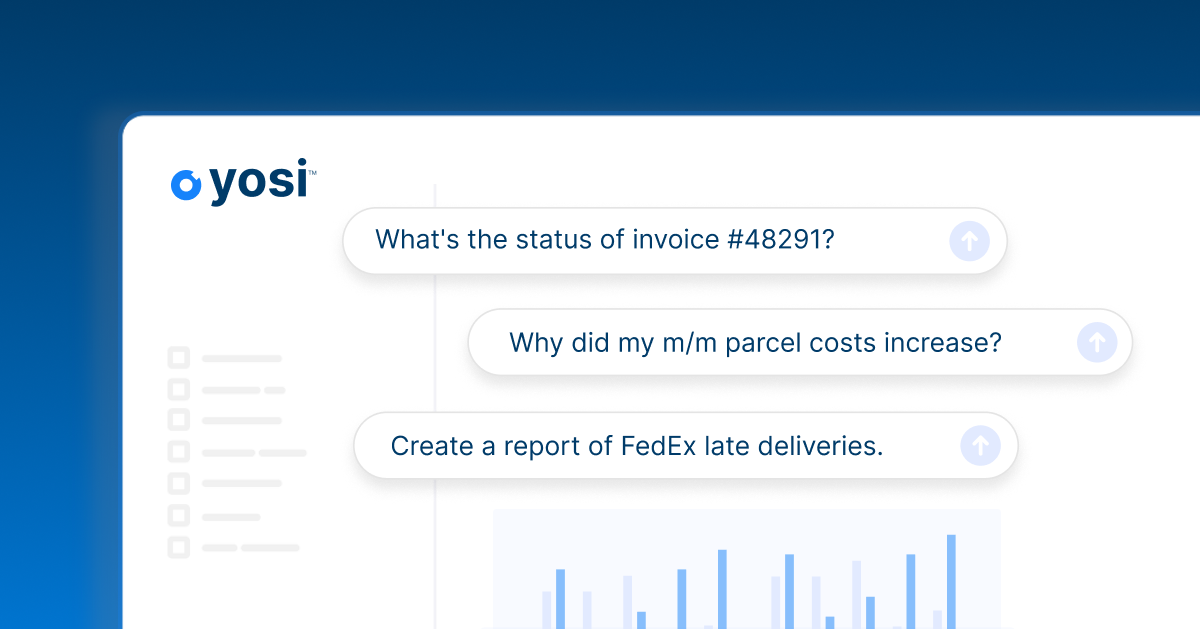
Intelligent Audit’s Yosi™ lets users explore transportation data through natural-language questions. A leader can ask which lanes drove a cost increase, where accessorial charges are rising, or which carrier is missing service expectations.
The system translates the question into analysis and returns an explainable answer. That brings logistics intelligence closer to the people making daily decisions.
What works
The strongest logistics AI applications share a few traits. They start with a specific decision. They use operational data that is current and trustworthy. They fit into the team’s workflow. And they measure a business result such as cost, service, speed, risk, or productivity.
The pattern is simple:
- Detect what changed.
- Predict what is likely to happen.
- Recommend the best response.
- Automate the action when the risk is understood.
- Learn from the outcome.
Not every use case needs full autonomy. In many cases, the best first step is a clear recommendation with a person making the final call.
Where to start
Start with a recurring decision that has enough data and a measurable cost. Good candidates include late-delivery risk, route exceptions, inventory imbalances, accessorial charges, carrier inquiries, and ETA accuracy.
Then define the action. A prediction has limited value if nobody knows what to do with it. Decide who will receive the insight, how quickly they need it, and which response the system may recommend or execute.
Finally, measure the result against a baseline. Track more than model accuracy. Measure avoided cost, service improvement, time saved, or risk reduced. AI will not improve logistics because it sounds advanced. It will improve logistics when it helps people make better decisions at operational speed.
Subscribe for more content!
Stay ahead of the curve in supply chain and logistics technology. Get practical insights on AI-driven automation, real-time visibility, and the tools reshaping how goods move—delivered straight to your inbox.