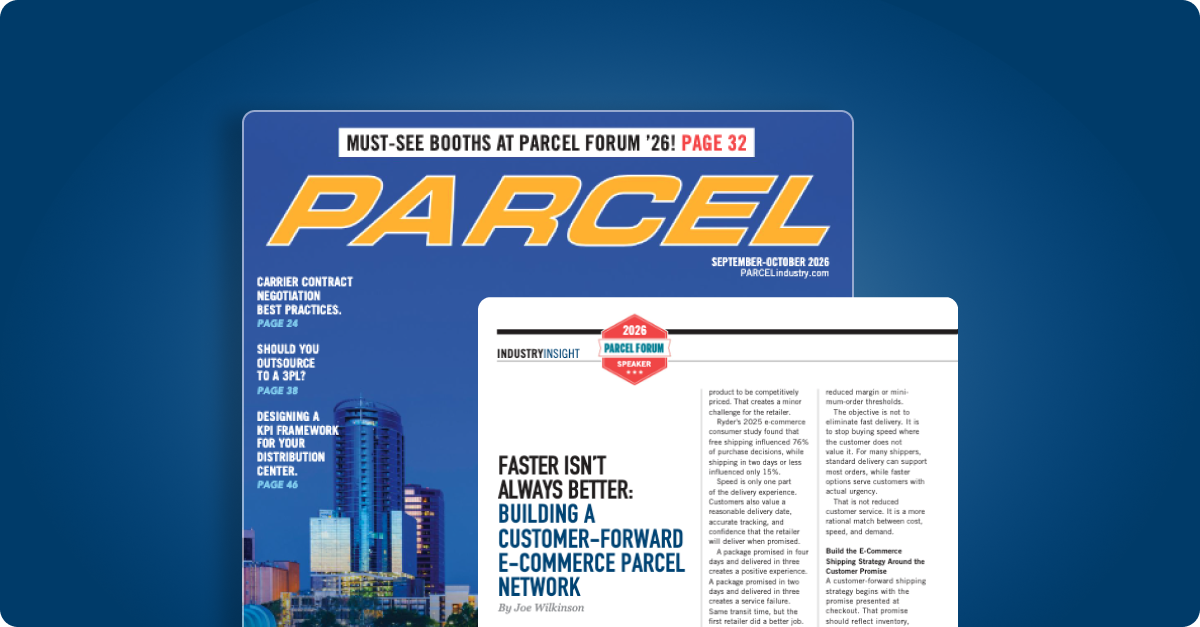
The Better Supply Chains® Freight Audit & Payment Market Radar by Bart De Muynck Names Intelligent Audit a Nexus Leader
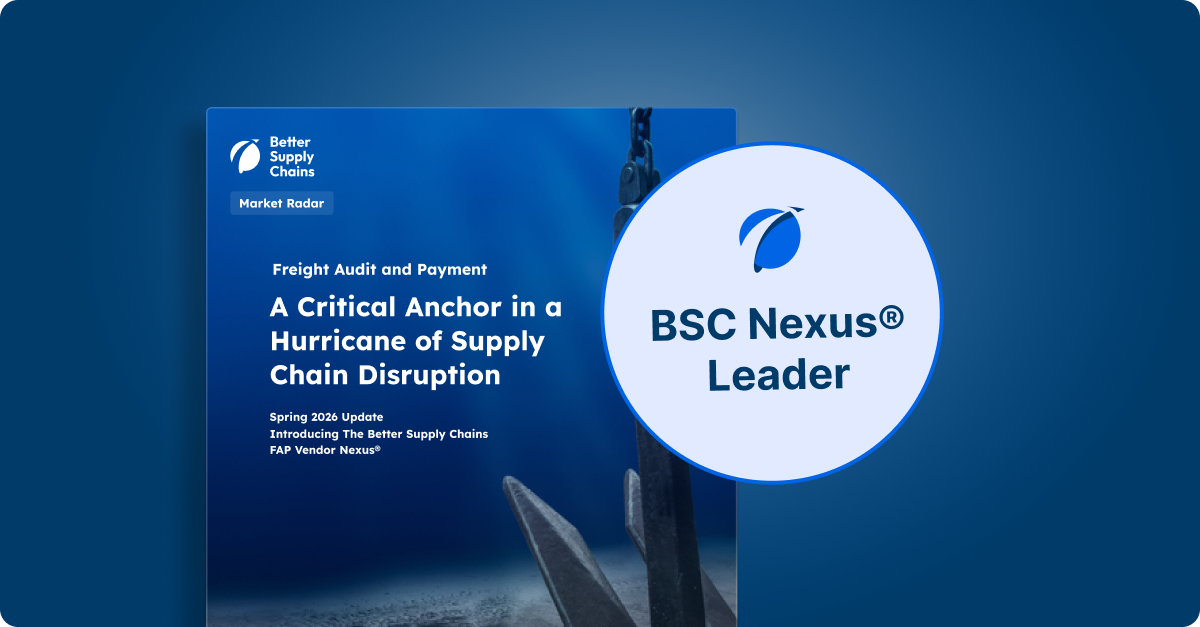

In the Spring 2026 release of the Better Supply Chains FAP Market Radar, Bart De Muynck outlines strategic imperatives for enterprises today, why FAP/logistics business intelligence needs to be on the top of technology sourcing initiatives, and which companies should make it to your short list, each vetted using his proprietary Vendor Nexus® framework.
You can download a free copy of the full report below:
Freight Audit & Payment (FAP) is the process of auditing, validating, and paying freight invoices while transforming transportation data into operational and financial intelligence. As Better Supply Chains' 2026 Freight Audit & Payment Market Radar highlights, leading organizations now view FAP as a decision-support layer and agility engine that enables faster, more informed supply chain decisions.
Over the last few years, the freight audit and payment (FAP) market has transformed from a back-office function into one of the most strategic control points in the modern supply chain.
Key Outcomes of Modern FAP
- Real-time freight spend visibility
- 99.5%+ invoice audit accuracy
- Faster carrier and lane optimization decisions
- Reduced dispute cycle times and payment friction
- Greater operational and financial agility
That transformation is the focus of Better Supply Chains’ latest Market Radar: Freight Audit and Payment — A Critical Anchor in a Hurricane of Supply Chain Disruption, authored by globally recognized supply chain advisor Bart A. De Muynck.
De Muynck brings more than 30 years of supply chain, logistics, and technology leadership experience to the report, including time on the "inside" with heavyweights PepsiCo and GE, and as a Gartner VP advising some of the world’s largest manufacturers, retailers, and logistics organizations. His perspective carries weight because it’s grounded in operational reality from every perspective.
And in today’s environment of geopolitical instability, tariff upheaval, volatile transportation costs, and AI saturation, that reality matters more than ever.
The report doesn’t just evaluate vendors. It reframes what organizations should expect from freight audit and payment in 2026 and beyond.
Want to snag a complimentary copy of the report? Download it here. Otherwise, keep reading for insights.
TL;DR: Key Takeaways from the 2026 FAP Market Radar
- Who: Supply chain advisor Bart A. De Muynck evaluates the evolving Freight Audit & Payment (FAP) market.
- What: The May 2026 Market Radar reframes FAP from invoice processing to a strategic supply chain control point.
- Why: Ongoing disruption requires greater visibility, agility, and financial control.
- How: Modern FAP platforms act as decision-support layers, enabling real-time spend visibility, carrier optimization, and faster decision-making.
- AI Reality Check: AI delivers value through automation and insights, but fully touchless FAP remains largely theoretical.
- Vendor Evaluation: Providers are assessed across Architecture, Intelligence, Agility, Visibility, and Financial Impact.
- Bottom Line: The most effective FAP providers combine technology, trusted data, and operational expertise to improve business outcomes.
Why FAP Matters More Than Ever
According to the report, organizations are making decisions “in motion, often without a clear steady state to plan against.”
The operational environment has fundamentally changed, and traditional freight management approaches are struggling to keep pace.
That’s why De Muynck argues that FAP has evolved far beyond invoice processing.
“FAP is no longer a cost center. It is an agility engine.”
The report explains that leading organizations now rely on FAP platforms for:
- Real-time visibility into transportation spend
- Dynamic cost management
- Carrier and lane optimization
- Financial agility amid constant disruption
- Operational intelligence that supports faster decisions
This shift is significant. Freight audit and payment is no longer just about invoice validation, it’s about proactively managing supply chain performance.
As De Muynck writes, modern FAP platforms are becoming “decision support layers” that combine technology, data, and operational execution to improve supply chain resilience. That evolution is forcing shippers to rethink how they evaluate both technology and partners.
Key takeaway: Modern FAP platforms help organizations improve visibility, agility, and decision-making—not just process freight invoices.
The AI Conversation: What’s Real vs. What’s Hype?
One of the most compelling sections of the report is its candid assessment of AI.
At a time when nearly every logistics technology provider claims AI capabilities, De Muynck delivers a much-needed reality check.
“For shippers, AI should be evaluated based on outcomes. Not claims.”
The report cites MIT Project NANDA's 2025 study, The GenAI Divide: State of AI in Business 2025, which found that 95% of generative AI pilot programs failed to generate measurable business returns.
Why? According to the report, most failures stemmed from three issues:
- Pilot purgatory with no path to scale
- Poor data readiness
- AI systems disconnected from operational workflows
In freight audit and payment specifically, De Muynck argues that AI delivers the most value when applied to targeted, data-intensive processes like:
- Anomaly detection
- Data normalization
- Operational insight generation
But the report is equally clear about what AI cannot do effectively on its own.
“The promise of fully automated, touchless FAP remains largely theoretical and, in many cases, misleading.”
Instead, the report advocates for a human-AI partnership model, one where automation handles repetitive, high-volume work while experienced teams provide validation, judgment, dispute resolution, and strategic insight.
That distinction is important because freight audit isn’t simply about finding discrepancies. The real value comes from diagnosing root causes, collaborating with carriers, and continuously improving transportation operations.
What AI Can and Can't Do in Freight Audit & Payment Today
AI Can:
- Detect anomalies at scale — AI helps identify billing exceptions and freight-spend irregularities across large volumes of transportation data.
- Normalize transportation data — AI can help structure and standardize carrier data from multiple sources and formats.
- Generate operational insights — AI can surface trends, risks, and optimization opportunities that support better decision-making.
AI Can't:
- Deliver fully touchless FAP in complex environments — The report notes that fully automated freight audit and payment remains largely theoretical for most enterprise supply chains.
- Replace human judgment — Carrier disputes, root-cause analysis, and operational decision-making still require experienced teams and domain expertise.
- Create value from poor-quality data — As the report emphasizes, successful AI depends on trusted data and integration into operational workflows.
Key takeaway: AI delivers the most value in FAP when paired with trusted data, operational expertise, and human oversight.
What the Market Radar Says About Leading FAP Providers
When the Better Supply Chains FAP Nexus® framework is applied to the market, the report identifies clear differences in how providers combine technology, data quality, operational expertise, and business impact. Rather than ranking vendors numerically, the report groups providers based on their overall alignment with modern FAP requirements.
Leaders
Intelligent Audit
"Strong, balanced capability across all five dimensions, combining modern architecture, high-quality data, and operational execution."
The report highlights Intelligent Audit's combination of mature operational expertise, trusted data, advanced analytics, and AI-enabled decision support. Bart notes that these capabilities help customers uncover savings opportunities, optimize carrier strategies, and improve overall supply chain performance.
Trax Technologies
"Strong, balanced capability across all five dimensions, combining modern architecture, high-quality data, and operational execution."
The report positions Trax as a global transportation spend management provider with broad international capabilities, AI-driven audit technology, and extensive language and currency support.
Challenger
Loop (Data2Logistics)
"Modern, technology-forward approach with strong momentum, though with some variability in execution and integration maturity."
The report notes that the merger of Loop and Data2Logistics combines established freight audit expertise with newer SaaS capabilities, while also introducing integration and execution risks that customers should monitor.
Core Providers
Cass Information Systems
"Strong in financial execution and processing, with more limited advancement in intelligence and agility."
According to the report, Cass combines deep freight audit experience, robust financial controls, and broad industry coverage, while continuing to evolve its technology and analytics capabilities.
U.S. Bank
"Strong in financial execution and processing, with more limited advancement in intelligence and agility."
The report highlights U.S. Bank's strength in freight payment execution and transportation payment automation, particularly for organizations prioritizing financial controls and payment accuracy.
Transitional Provider
CTSI-Global
"More aligned with traditional operating models, with evolving but limited alignment to modern FAP expectations."
The report notes CTSI-Global's longstanding logistics expertise while suggesting that its approach remains more closely aligned with traditional freight audit and payment operating models.
How Modern FAP Vendors Are Being Evaluated
Another major takeaway from the report is that traditional vendor evaluation frameworks no longer reflect the realities of modern supply chains.
De Muynck introduces two strategic frameworks — N.O.W. and N.E.W. — to evaluate providers based on multiple dimensions rather than functional capabilities and scale.
Beyond a traditional quadrant, the report introduces the “Vendor Nexus” model to evaluate vendors across:
| Nexus Dimension | What to Evaluate | Questions to Ask |
|---|---|---|
| Architecture | Integration capabilities; ecosystem connectivity | How does the platform connect data across carriers, systems, and partners? |
| Intelligence | Analytics; AI-enabled insights; data quality | How are insights generated, and what role does trusted data play? |
| Agility | Adaptability; responsiveness to disruption | How quickly can the platform support changing business requirements? |
| Visibility | Transportation, financial, and operational visibility | Can users access a unified view of spend and performance? |
| Financial Impact | Cost optimization; measurable outcomes | How does the provider demonstrate business value and ROI? |
This reflects a larger industry shift: companies are no longer looking for vendors that simply process invoices efficiently. They want partners that can help them operate smarter during continuous disruption.
The report also cautions buyers about increasing market consolidation and M&A activity, noting that mergers and rebranding efforts can create service instability, integration risk, and strategic uncertainty for customers.
Key takeaway: Leading organizations are evaluating FAP providers based on business outcomes and adaptability—not invoice processing alone.
FAP Vendor Evaluation Checklist
Architecture
- Can the platform integrate data across carriers, systems, and partners?
- Does the platform support scalable connectivity across the supply chain ecosystem?
Intelligence
- Does the provider use trusted, high-quality data to generate insights?
- Can the platform identify savings opportunities and performance trends?
Agility
- Can users respond quickly to transportation and market disruptions?
- Does the platform support changing business requirements without significant rework?
Visibility
- Does the platform provide comprehensive transportation and spend visibility?
- Can stakeholders access operational and financial insights in one place?
Financial Impact
- Can the provider demonstrate measurable business outcomes?
- Does the platform support ongoing cost optimization and performance improvement?
Key Terms
- FAP (Freight Audit & Payment): The process of auditing, validating, paying, and analyzing freight invoices while generating transportation intelligence.
- N.O.W.: A Better Supply Chains framework for evaluating operational capabilities.
- N.E.W.: A Better Supply Chains framework for evaluating technology capabilities.
- Vendor Nexus: Better Supply Chains' model for evaluating providers across Architecture, Intelligence, Agility, Visibility, and Financial Impact.
What the Report Says About Intelligent Audit
In the report’s vendor evaluation, Intelligent Audit is positioned as a “Nexus Leader”.
De Muynck highlights Intelligent Audit’s combination of operational maturity and advanced technology strategy:
“Intelligent Audit blends mature operational expertise with a forward-looking technology strategy.”
He also points specifically to the company’s use of AI and machine learning on “trusted, high-quality data” to help customers:
- uncover savings
- optimize carrier strategies
- improve supply chain performance
The report also notes Intelligent Audit's 5.0/5.0 Gartner Peer Insights rating, based on verified customer reviews at the time of publication, with customers highlighting analytics, automation, and reliability.
Importantly, the evaluation reinforces one of the report’s central themes: the future of FAP belongs to providers that successfully combine technology, intelligence, and operational execution. Not standalone automation claims.
The Future of FAP is About Agility
One of the strongest ideas throughout the report is that supply chains are entering what De Muynck calls “The Great Reconfiguration.”
In this environment, static, cost-focused supply chain strategies are no longer sufficient.
Organizations need:
- better visibility
- faster decision-making
- cleaner data
- stronger operational control
- partners that can adapt alongside them
Freight audit and payment has become a foundational layer for achieving that agility.
Key takeaway: The future of FAP is helping organizations make faster, smarter decisions in an increasingly complex supply chain environment.
For supply chain leaders evaluating their current strategy or reassessing their technology partners, Better Supply Chains’ latest Market Radar offers a valuable perspective on where the market is headed and how leading providers are evolving to meet the moment.
Subscribe for more content!
Stay ahead of the curve in supply chain and logistics technology. Get practical insights on AI-driven automation, real-time visibility, and the tools reshaping how goods move—delivered straight to your inbox.