Beyond the Headline: UPS 2027 GRI Analysis


Updated November 5, 2026. Expanded to include UPS’s published 2027 rate and surcharge previews.
UPS will raise its published daily rates for UPS Ground, air and international services by an average net 5.9% effective December 21, 2026. That matches the announced increase for 2026, which began December 22, 2025. The familiar headline is accompanied by faster increases in several common surcharges and a change to how some packages are billed.
For many shippers, the most consequential changes will be higher residential and delivery area fees, increased handling and large package charges, and a higher minimum billable weight for affected packages. The impact will depend on how frequently those charges apply and the discounts and protections in each UPS agreement.
Where selected UPS fees rise fastest
Highest percentage increase within each selected domestic fee group
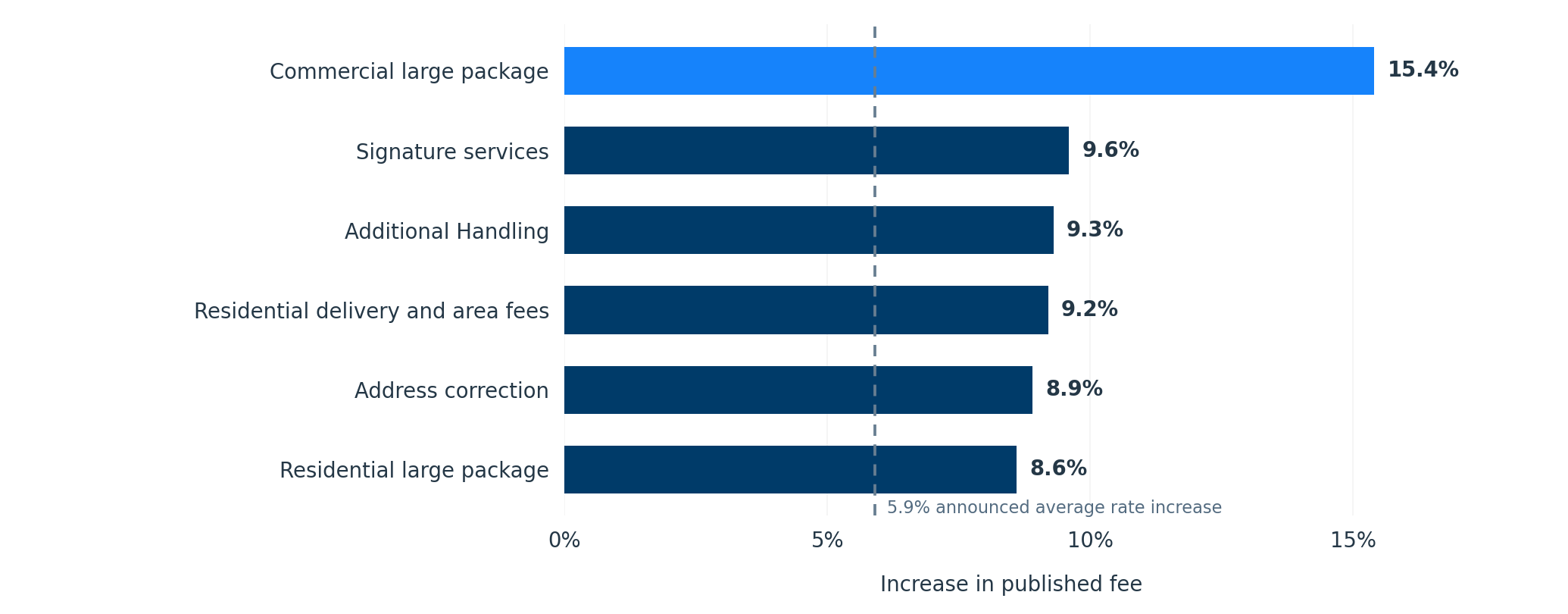
2026 to 2027 published fees. Rounded to one decimal place. Fee groups are not exhaustive.
The 5.9% reference applies to the announced average transportation rate increase, not to every surcharge.
Lightweight Ground packages face higher average increases
Package weight also affects the transportation increase. Across UPS Ground Zones 2–8, published rates rise an average of 6.13% for packages billed at one to five pounds, compared with 5.60% for packages billed above 30 pounds.
Average change in published UPS Ground transportation rates by weight band

Zones 2–8, weights 1–150 lb. Simple average of individual rate-cell percentage changes within each band.
Not weighted by shipment volume. Excludes discounts, minimum adjustments, fuel, and surcharges.
For shippers whose volume concentrates in lighter packages, that mix matters. A forecast should reflect the service, weight and zone combinations the business actually ships, then apply its agreement terms and any additional fees.
Residential delivery fees: +9.2%
The UPS Ground residential surcharge rises from $6.50 to $7.10 per package, an increase of 9.2%. The standard residential delivery area surcharge also increases by 9.2%, from $6.55 to $7.15. Extended residential delivery area fees rise approximately 9.0%, reaching $9.65 per package.
Where both the Ground residential surcharge and the standard residential delivery area surcharge apply, the two fees add $1.20 more per package before transportation increases, fuel and negotiated discounts.
Because these charges recur across qualifying shipments, their frequency can make them a significant source of additional cost for residential delivery operations.
| Surcharge | 2026 | 2027 | Increase |
|---|---|---|---|
| UPS Ground residential | $6.50 | $7.10 | 9.2% |
| Standard residential delivery area | $6.55 | $7.15 | 9.2% |
| Extended residential delivery area | $8.85 | $9.65 | 9.0% |
Per-package fees, before transportation increases, fuel, and negotiated discounts. 2027 rates take effect December 21, 2026.
Additional handling fees: +9.3%
Domestic additional handling fees increase approximately 8.5% to 9.3% across the published weight, dimension and packaging categories. The new charges range from $29.25 to $63.75 per package, depending on the handling category and zone.
| Type | Zone | 2026 | 2027 | Increase |
|---|---|---|---|---|
| Weight | 2 | $46.50 | $50.50 | 8.6% |
| Weight | 7+ | $58.75 | $63.75 | 8.5% |
| Size | 2 | $30.00 | $32.75 | 9.2% |
| Size | 7+ | $40.50 | $44.00 | 8.6% |
| Packaging | 2 | $26.75 | $29.25 | 9.3% |
| Packaging | 7+ | $33.75 | $36.75 | 8.9% |
Selected domestic fees per package, effective December 21, 2026. Packaging examples are not exhaustive.
When the fees apply:
- Weight: Actual weight over 50 lbs.
- Size: Longest side over 48", second-longest side over 30", length plus girth over 105", or volume over 10,368 cubic inches.
- Packaging: Includes non-corrugated containers, cylindrical items, and soft-sided packs exceeding 18" long, 14" wide, or 6" high.
UPS will also increase the additional handling minimum billable weight from 40 to 50 pounds. The current minimum applies to certain packages assessed additional handling because of their dimensions. For affected packages whose billable weight is governed by that minimum, the change raises the weight used to calculate transportation charges.
This creates two potential sources of added cost on the same shipment: a higher handling fee and a higher transportation charge. Bulky products with relatively low actual weight can be particularly exposed. Packages already billed at 50 pounds or more would not see an increase from the higher floor alone.
Large package surcharges bring some of the steepest increases: +15.4%
Commercial large package surcharges increase approximately 11.7% to 15.4%, with published fees ranging from $250 to $330 per package. Residential large package surcharges rise approximately 8.5% to 8.6%, with the highest published fee reaching $359.25. These amounts are separate from transportation charges and any applicable fuel or other fees.
| Delivery | Zone | 2026 | 2027 | Increase |
|---|---|---|---|---|
| Commercial | 2 | $219.50 | $250.00 | 13.9% |
| Commercial | 3–4 | $239.50 | $275.00 | 14.8% |
| Commercial | 5–6 | $273.00 | $305.00 | 11.7% |
| Commercial | 7+ | $286.00 | $330.00 | 15.4% |
| Residential | 2 | $254.50 | $276.25 | 8.5% |
| Residential | 3–4 | $274.50 | $298.00 | 8.6% |
| Residential | 5–6 | $320.50 | $347.75 | 8.5% |
| Residential | 7+ | $331.00 | $359.25 | 8.5% |
The commercial increases stand well above the headline GRI. For businesses shipping bulky merchandise, the dollar amount of the surcharge can make package size a major determinant of the total shipping bill. The effect can be concentrated in a relatively small group of products even when most shipments avoid the charge.
ZIP code changes can add costs at both ends of a shipment
UPS is changing its area surcharge ZIP code lists and certain ZIP-to-zone alignments on December 21, 2026. It has also announced an additional per-package surcharge for qualifying customers shipping domestic Ground and Ground Saver packages from certain origin ZIP codes. Together, these changes make both shipping origins and delivery destinations relevant to the total increase.
For a residential destination newly subject to a standard delivery area surcharge, the published 2027 fee would add $7.15 per package. An extended-area classification would carry a $9.65 fee, before fuel and applicable discounts. These are potential costs for newly affected destinations; UPS’s announcement alone does not establish which ZIP codes are being added or reclassified.
Zone changes can also affect more than transportation rates because some surcharges vary by zone. For example, the published 2027 commercial large package surcharge is $275 in Zones 3–4 and $305 in Zones 5–6. A shipment moving between those groups could face a $30 surcharge difference alongside any change in its transportation charge.
| Change | What it affects | Potential cost impact |
|---|---|---|
| Area surcharge ZIP lists | Whether a destination incurs an area surcharge | A newly affected residential destination could add $7.15 for standard or $9.65 for extended delivery area. |
| ZIP-to-zone alignments | Transportation rates and zone-based surcharges | Moving from Zones 3–4 to 5–6 would increase the 2027 commercial large package surcharge from $275 to $305. |
| Origin-based surcharge | Certain Ground and Ground Saver shipments for qualifying customers | An additional per-package fee based on the shipping origin; amounts and ZIP codes pending verification |
Examples illustrate potential exposure, not confirmed ZIP code reassignments. Fees exclude fuel and applicable discounts.
Routine services also become more expensive
Increases extend to other frequently used services. Standard signature-required fees rise approximately 9.1%, adult signature fees rise 9.6%, and address correction fees increase 8.9%. Their contribution to the annual increase will depend on how often the business uses or incurs each service.
| Service | 2026 | 2027 | Increase |
|---|---|---|---|
| Signature required | $7.70 | $8.40 | 9.1% |
| Adult signature required | $9.35 | $10.25 | 9.6% |
| Address correction | $25.25 | $27.50 | 8.9% |
Per-package fees, effective December 21, 2026. Address correction rates shown apply to domestic Ground and Air.
The same headline carries a different cost impact
Intelligent Audit's analysis of the 2026 UPS GRI described most surcharge increases as approximately 6% to 7%, with some larger exceptions. For 2027, common domestic handling, residential and delivery area fees generally increase approximately 8.5% to 9.5%. The distinction from last year is therefore visible in the recurring charges surrounding the transportation rate.
The 5.9% announcement remains an average rather than a uniform increase across every service, weight and zone. Contractual minimums, discounts and surcharge provisions also affect the net result. Fuel can apply to transportation and specified surcharges, so higher underlying charges can increase fuel dollars even if the fuel percentage stays the same.
For 2027, residential delivery frequency, package size and geographic mix will help explain why two shippers can experience different increases under the same published GRI. The total effect combines higher rates, higher fees and changes in the rules that determine how a shipment is billed.
What now? Build a plan before December 21
Build a budget that reflects the shipping profile
Reprice recent shipment history under the 2027 schedules using actual discounts and minimum charges. Hold volume and shipment characteristics constant first, then incorporate expected growth, product mix and fulfillment changes. Separate transportation, surcharges, fuel and rule changes, and review the results by business unit, product family and customer segment.
Address package size and billable weight
Prioritize frequently shipped products near handling or large package thresholds, particularly dimension-based handling packages currently billed below 50 pounds. Evaluate packaging, service and carrier alternatives using the full cost, including materials, labor, delivery requirements and potential damage.
Test contract protection and geographic exposure
Confirm which transportation rates, fees, minimum charges and billing changes each contractual protection covers. Assess revised geographic mappings by fulfillment location and destination concentration, and check origin-based surge charges separately. Model international traffic under its own service and fee rules.
Set clear actions before and after December 21
Assign owners and deadlines to the changes with the greatest expected savings, and confirm shipping systems reflect the applicable rates, rules and geographic mappings.
After the first full invoice cycle, compare actual charges with the forecast, accounting for changes in volume and mix. Track net cost per package, billable weight and major surcharge frequency to investigate unexpected charges and confirm that negotiated protections are working.
Turn the rate announcement into a cost plan
Intelligent Audit combines shipment-level analytics, parcel expertise and modeling to help shippers understand where carrier changes affect their costs. With a clear view of the products, locations and charges driving the increase, teams can prioritize changes and validate the results.
Subscribe for more content!
Stay ahead of the curve in supply chain and logistics technology. Get practical insights on AI-driven automation, real-time visibility, and the tools reshaping how goods move—delivered straight to your inbox.