What Nordstrom Taught Us About Carrier Diversification at PARCEL Forum 2026

For parcel shippers, diversification is often discussed as a way to reduce costs, add capacity, or protect the network from disruption. But simply adding carriers does not automatically create resilience.
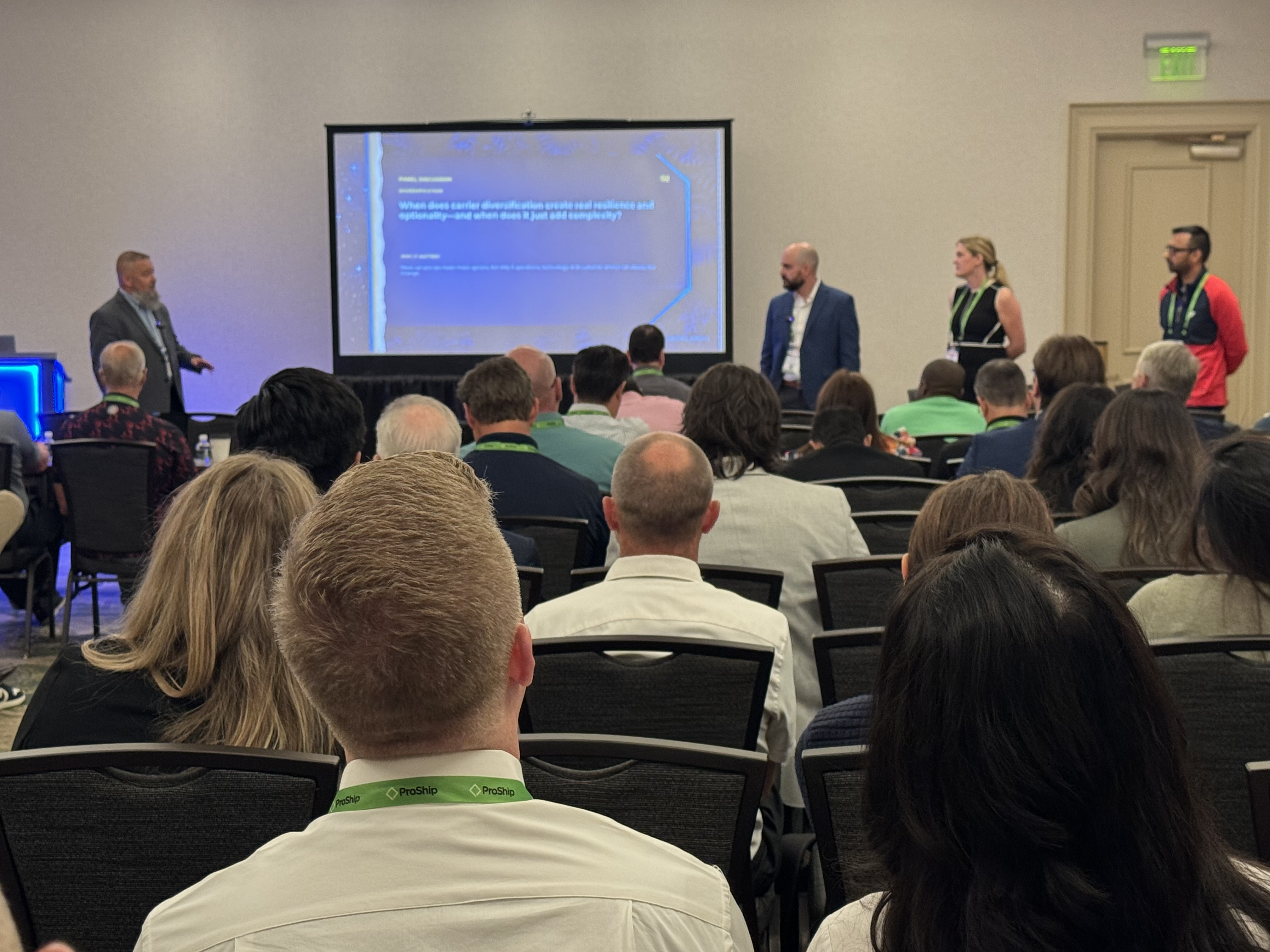
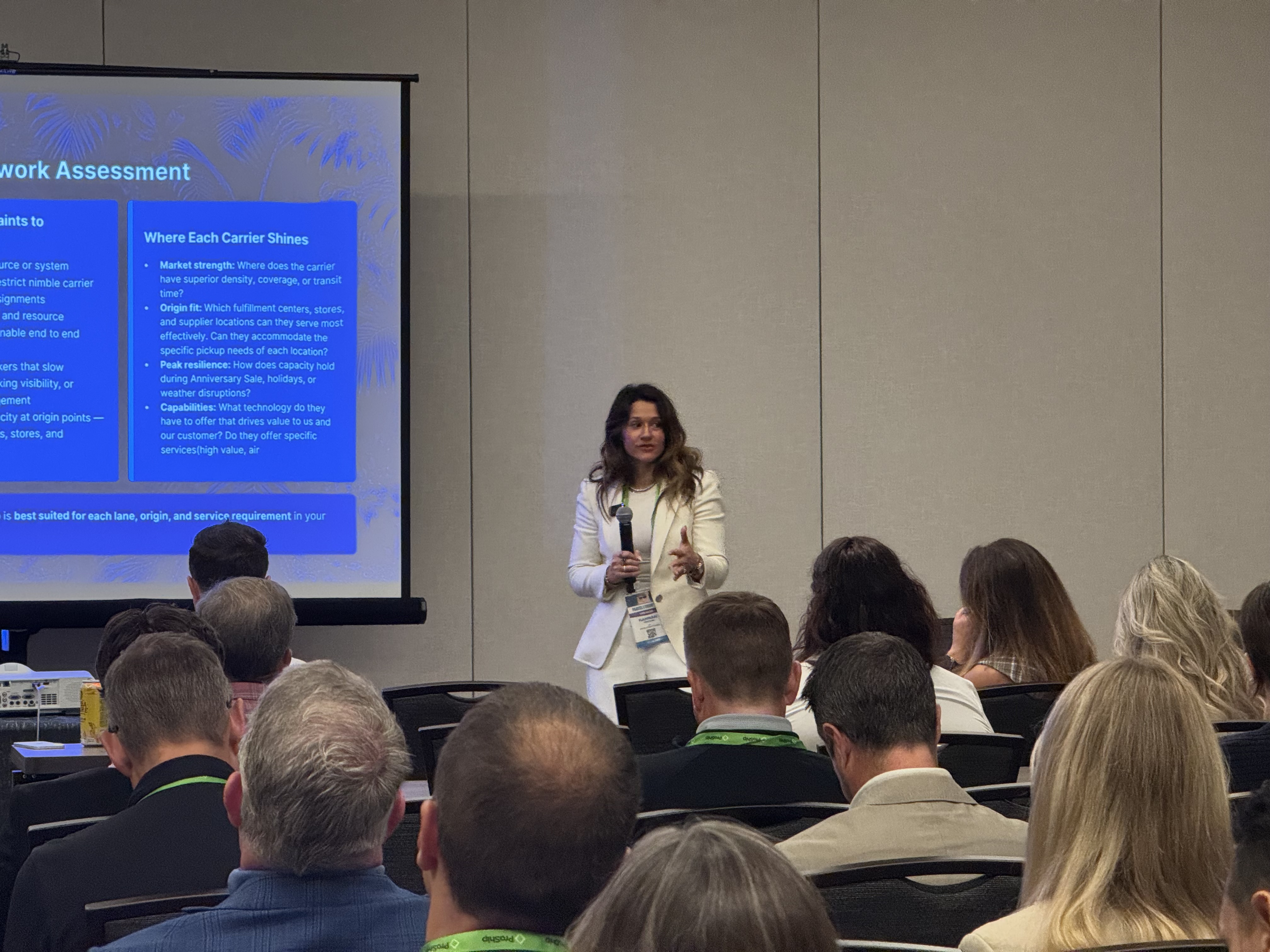
At Parcel Forum 2026, our CEO Hannah Testani took the stage with Kevin Breedlove and Parker Bushaw, leaders within Nordstrom’s transportation operations and strategic sourcing teams, to share a more disciplined approach.
The overarching message was clear: A diversified carrier network should be built around specific customer and business needs, not the number of carriers in the portfolio.
Here are the most important takeaways for shippers.
Start With the Customer Promise
Nordstrom’s parcel strategy begins with a simple question: What experience has the company promised its customer?
That promise informs decisions across inventory placement, fulfillment, transportation, and carrier selection. When an order is placed, Nordstrom’s systems evaluate how to deliver it effectively while balancing several priorities.
Package consolidation is one consideration. One shipment may be better than two or three for both the customer and the business. But consolidation cannot come at the expense of the promised delivery date.
The same principle applies during carrier negotiations.
“If the goal is a two-day promise, securing a great rate for a three-day promise is a bad deal,” Parker said.
Cost matters, but only within the context of the outcome the business needs to deliver.
Diversification Must Solve a Defined Problem
Adding carriers creates operational and technological complexity. That complexity should have a clear purpose.
As Parker explained:
“Diversification for diversification’s sake really isn’t going to accomplish anything. What do you diversify for? Is this a cost play? Is this a speed play? Is this a capability need?”
Before expanding the carrier base, shippers should be able to explain whether they are addressing:
- A capacity risk
- A service or speed requirement
- A geographic coverage gap
- A specialized capability
- A cost opportunity
- A need for greater resilience
Nordstrom uses national carriers to provide broad pickup and delivery coverage, including service across all 50 states, U.S. territories, and military destinations overseas. Regional carriers complement that foundation in dense markets where they may provide additional capacity, competitive service, or greater flexibility.
The resulting network is diversified by design. Each carrier fills a specific role instead of becoming another option added for diversification’s sake.
Operations and Procurement Must Share Goals
Transportation operations and procurement often sit in different parts of an organization. Without intentional alignment, the two teams can pursue competing objectives, with service performance on one side and rate reduction on the other.
Nordstrom’s teams work to avoid that conflict by establishing shared priorities before entering a negotiation.
Frequent communication keeps both groups informed about carrier performance, customer feedback, financial goals, operational constraints, and emerging needs. From there, they develop a clear list of must-haves and nice-to-haves.
Parker described the process as a series of conversations that happen well before anyone enters a negotiation room.
“Once we’re able to anchor ourselves in that end goal, you just kind of work backwards from there,” he said.
This changes the nature of the sourcing process. The conversation is no longer simply, “How low can the rate go?” It becomes, “Which problems must this carrier solve, and what is the best rate available for that solution?”
Procurement also remains engaged after contracts are signed. When persistent performance problems arise, or when Nordstrom is preparing for major volume events such as the holiday season and its Anniversary Sale, strategic sourcing helps evaluate the broader commercial and network implications.
Document the Strategy; Engage Stakeholders Early
Carrier decisions affect far more than transportation.
Store operations, fulfillment centers, inventory teams, customer care, finance, marketing, product, engineering, and dropship suppliers may all be affected by a new service or carrier integration.
Nordstrom uses detailed strategy documents to capture customer needs, operational requirements, constraints, and expected outcomes. Stakeholders can review those plans, provide feedback, and understand why particular tradeoffs are being made.
As Parker noted, the documentation helps Nordstrom move beyond a rate-focused exercise.
“We’re telling the story of what we’re trying to do to best deliver for our customer,” he said. “It lets us break out from just, ‘How cheap can we get this?’ and get to a point where we’re solving specific problems in the business.”
That visibility is especially important because requirements can differ significantly across the network. A large fulfillment center, a full-line store, a smaller Nordstrom Rack location, and a dropship supplier may have very different sortation space, pickup, technology, and service constraints.
A carrier that works well in one part of the network may not be operationally viable in another.
Measure the Accuracy of the Promise
Speed is important, but customers also expect precision.
A shipper can produce an excellent on-time percentage by giving customers highly conservative delivery estimates. That protects the metric, but it does not necessarily create a competitive experience. At the other extreme, an aggressive promise may look attractive until packages begin arriving late.
“Late is always worse than early, but customers are more and more expecting precision with that promise,” Kevin said.
Nordstrom evaluates both the speed and accuracy of its delivery promise. The company also incorporates feedback from customer care, including the reasons customers contact the company during regular periods and major volume events.
This creates a broader performance picture that may include:
- On-time delivery to promise
- Promise accuracy
- In-transit speed
- Delivery visibility
- Customer feedback
- Conversion and repeat visits
- Cost
- Carrier exceptions and escalations
Accurate delivery windows can also help customers plan to receive their packages, reducing the amount of time shipments are left unattended after delivery.
Treat Carriers as Part of the Customer Experience
Parcel carriers represent the final physical interaction in the ecommerce experience. In many cases, the delivery itself becomes the retailer’s face at the customer’s door.
That is why Nordstrom treats carriers as important external stakeholders rather than purely transactional vendors.
“We view our parcel carriers as a super important stakeholder,” Kevin said. “They just happen to be external.”
Hannah captured the mindset shift required to build those relationships:
“What I hear all the time is, ‘It’s me versus the carriers,’ and that is not the win,” Hannah said. “It needs to be you plus the carriers. Being transparent with them is a winning solution.”
Nordstrom holds an annual carrier summit to share its priorities for the next one to three years and learn about carriers’ service plans, capabilities, and investments. That strategic discussion is followed by semiannual reviews, monthly and weekly performance conversations, and daily exception management when necessary.
The goal is not to use every performance problem as an opportunity to extract a concession. Parker said that, in most cases, he would rather see the carrier correct the underlying issue.
This requires transparency and shared accountability. Carriers need enough visibility into forecasted volume, upcoming initiatives, service expectations, and long-term strategy to invest and plan alongside the shipper.
Kevin reinforced that point in his closing advice:
“It’s not just transactional in nature. It’s really important to form those lasting relationships and be very transparent when there are pros, cons, and opportunities.”
Account for the True Cost of Complexity
Hannah also raised an important practical question:
“Diversification is important. You have to be resilient. But is there ever a time where it’s too much? Does it take too much work for your team?”
A more diversified network requires additional integrations, performance monitoring, operational processes, and relationship management.
Shippers therefore need to look beyond the transportation rate and consider whether a carrier’s service is:
- Measurable
- Scalable
- Compatible with existing technology
- Operationally sustainable
- Resilient during peak periods
- Financially viable over the long term
Diversification can help offset weaknesses by creating backup options and alternative paths. But maintaining those options may come with additional costs.
The objective is not to build a perfectly diversified network. The objective is to create a flexible network in which carrier strengths align with specific business needs and weaknesses are offset by viable alternatives.
Write it Down
Nordstrom’s approach offers a useful reminder for any shipper evaluating its parcel network: Write down the problem before selecting the solution.
Define the customer outcome. Identify the operational and technical constraints. Align transportation, procurement, and other stakeholders. Then determine which carrier, or combination of carriers, can deliver the required capability at the right cost.
Diversification works when every carrier has a reason to be in the network. Without that clarity, it is simply added complexity.
Subscribe for more content!
Stay ahead of the curve in supply chain and logistics technology. Get practical insights on AI-driven automation, real-time visibility, and the tools reshaping how goods move—delivered straight to your inbox.