A Higher Standard for Freight Audit and Payment

A freight audit and payment (FAP) provider should help transportation teams spend less and ship smarter.
At Intelligent Audit, we view the evolution of FAP as moving from “checking invoices” into becoming a strategic control center. Accurate invoice validation and reliable payment remain essential. They also create the foundation for identifying emerging problems, questioning costly assumptions, and evaluating changes to contracts, services, and carrier networks.
As AI makes more audit tasks easier to automate, buyers should look closely at what distinguishes one provider from another. The ability to perform an audit is table stakes. The deeper value comes from what a provider can uncover, how it connects findings to your operation, and what it helps your team do next.
That requires accurate validation, complete coverage, and people who carry findings through resolution. It also requires capabilities that help teams detect unusual activity, compare performance, model alternatives, and get answers when questions arise.
Recovery, Prevention, and Optimization in Sync
A shipment’s price isn’t always final when the label prints. According to UPS, a package shipped with incorrect details can pick up shipping charge corrections. Fix the weight at the dock, and that correction may never appear on the bill.
That’s prevention, and good audit programs use it. Intelligent Audit groups the value of audit into three categories: recovery, prevention, and optimization.
Recovery gets attention because refunds are easy to count. Prevention matters because it stops the same problem from generating costs again. Optimization takes the work further by examining whether a different service, contract structure, or shipping decision could meet requirements more efficiently.
Ask a provider to connect those activities. Can it trace an overcharge to its cause, help correct the issue, and confirm that subsequent invoices reflect the fix? Can it use what it learns to identify other opportunities?
That is how individual findings become lasting improvements.
Who Checks the Expected Cost?
An expected shipping cost is a useful reference point. It is also only as good as the contract terms, effective dates, discounts, and rules used to calculate it. If those are wrong, an invoice can match the expected cost perfectly and still overstate what you owe.
Contract terms move more than many teams anticipate. A large online home furnishings retailer learned that a carrier’s contract amendment had displaced its existing surcharge discounts. Ongoing invoice validation identified $3.5 million in overcharges.
Each change must reach the rating logic for expected cost to stay accurate. Ask how the provider establishes the correct charge, maintains contract versions, and tests its calculations.
Then ask what happens when an invoice matches the expected cost but the expectation itself is wrong.
A provider should be able to explain how it detects that shared mistake. Request a demonstration using an amendment, an expired discount, or a change in surcharge treatment.
Automation Needs Proof of Accuracy
High auto-approval rates can reduce manual work. Buyers still need evidence that those approvals are correct.
Some of the costliest problems are billed exactly as the rules say they should be. Intelligent Audit has documented cases where the billing looked right, but the circumstances were wrong, including a service-selection system glitch with $4.4 million a year in potential exposure and a failure to update an API with $1.6 million a year in potential exposure.
A charge-level check may confirm the rate while leaving the operational problem unexamined.
Ask any provider to walk through an invoice that passed its initial checks but later warranted investigation. What exposed the issue? Was it a validation problem, unusual activity, or an operational decision? How did the provider determine its scope and help prevent a repeat?
The answers reveal how the provider evaluates its own work and handles problems beyond familiar billing discrepancies.
Coverage Must Be Demonstrated
Transportation spend rarely originates in one system. Warehouses, business units, return programs, marketplaces, and third parties can all ship on the same carrier accounts. Some charges may have incomplete shipment records or no matching record in the systems your team normally reviews.
Take one global manufacturer with 12 business units and nine fiscal entities, running SAP, Oracle, and a legacy TMS side by side. It had no single view of its total transportation spend.
After consolidating freight audit and reporting with Intelligent Audit, the manufacturer gained visibility into 100% of its global freight. Freight cost leakage dropped 7.8%, and finance spent 40% less effort on reconciliation.
Ask a prospective provider to account for your full transportation footprint. Which modes, carriers, accounts, regions, and invoice formats does it cover? How does it identify missing information, and what happens when a charge cannot be matched to an authorized shipment?
Request a demonstration with a third-party label, an unfamiliar return, and a charge with no supporting shipment record. See how each is investigated and resolved.
A Valid Rate Doesn’t Equal Authorized Activity
A shipment can be priced correctly and still involve unauthorized use of a carrier account. Detecting that activity requires an understanding of what normally happens across the account.
Two Intelligent Audit cases illustrate the distinction:
- An eyewear manufacturer’s bill showed a $10,000 spike in a return service it had never used. Investigation uncovered compromised UPS accounts and altered ship-to addresses. More than $1 million in fraudulent activity was detected.
- A UPS shipper account showed a steep rise in international returns from Mexico that didn’t match its outbound volume. Intelligent Audit estimated the scheme could have cost $500,000 a year.
Account behavior provided the warning. A new service, route, or return pattern stood out against the shipper’s history.
DeepDetectAI™ adds this kind of pattern analysis to Intelligent Audit’s work, helping identify unusual activity that warrants investigation.
Ask providers how they establish normal behavior, identify meaningful deviations, and prioritize alerts. Then ask who investigates and what support your team receives when something needs attention.
Early Validation Stops Errors From Piling Up
Speed matters throughout the process: when validation runs, when a finding reaches the right person, and how quickly someone acts.
One of the largest online furniture and home goods retailers previously confirmed its FedEx billing through internal quarterly or twice-yearly reviews. It moved to a pre-audit model with Intelligent Audit, checking invoices before payment and filing disputes promptly.
The change produced more than $70,000 in contractual audit recovery in the first two months. By month six, the retailer achieved its first dispute-free month, then repeated it in month seven. In month eight, continued validation caught a carrier configuration bug and flagged nearly $500,000 CAD in disputed invoices.
That sequence demonstrates what buyers should look for: early identification, corrections that reduce recurring errors, and continued monitoring when something new changes.
Ask providers to demonstrate the timeline from finding to intervention. Include the work your team must perform and how the provider confirms the issue has been addressed.
Correctly Billed ≠ Cost-Effective
A shipment can be legitimate, priced correctly, and invoiced accurately while still carrying avoidable costs.
A global furniture retailer found this when Intelligent Audit reviewed its shipments to Alaska and Hawaii. Its internal modeling tool never compared ground with air because, as a parcel manager explained, “the assumption is ground will always win.”
For those destinations, FedEx 2Day was significantly less expensive than Ground and Home Delivery. Across 624 shipments over four months, the analysis identified $143,452 in potential savings, representing a $430,355 annualized opportunity.
The opportunity came from questioning a service-selection assumption.
Ask how a provider helps you evaluate those decisions. Can your team use self-service modeling tools to compare contracts, test carrier allocations, or examine network changes against your actual shipment profile and delivery requirements?
Relevant peer comparisons can help identify where to investigate, too. PeerIntel™ lets teams compare transportation performance with similar shippers, adding context around delivery reliability, transit times, and shipment characteristics.
The value lies in connecting the work: identify a difference, investigate its cause, test an alternative, and determine whether a change makes sense for your operation.
Intelligence Should Be Accessible
Transportation teams also need a practical way to explore what the findings mean.
A finance leader asks why costs increased. A transportation manager wants to know which locations contributed. An operations leader may ask whether service selections changed.
Answering those questions can require several reports and someone who knows how to connect them. Conversational access makes that intelligence easier to use as the questions develop.
The depth behind the interface matters. A chatbot can return a fluent response. Meaningful transportation analysis depends on the information it can access, the relationships it can examine, and its ability to explain what drove a result.
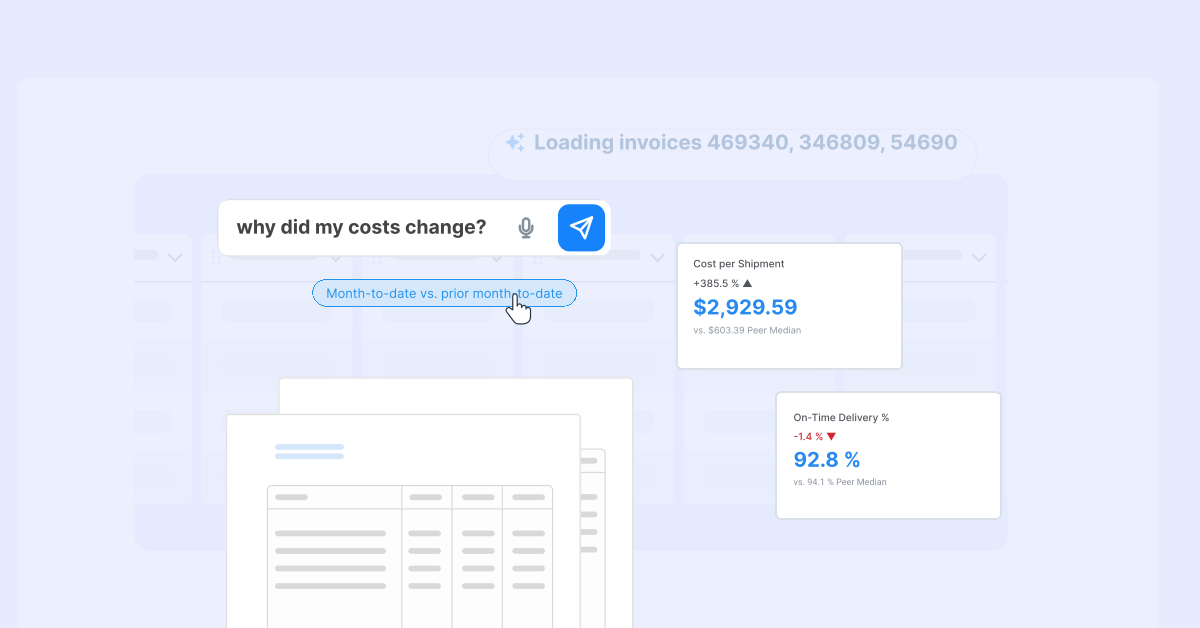
Yosi™, Intelligent Audit’s always-on transportation superintelligence, brings IA’s intelligence into a conversation. Its value comes from the proprietary connections within the platform: how Intelligent Audit brings transportation data together, validates it, and makes related information available for analysis.
Ask why cost per shipment increased, then explore the locations, services, or shipment characteristics contributing to the change. Continue with follow-up questions to understand where an issue is concentrated and what deserves further investigation.
When evaluating conversational capabilities, ask providers to demonstrate that depth with your own business questions. What can the tool access? Can it explain the drivers behind a result? Does it respect the user’s permissions? Does it acknowledge when it cannot answer?
The test is whether your team can reach a useful, supported explanation and determine its next step.
Eight Questions to Ask
Use these questions to connect the provider’s capabilities with evidence of how it works.
- Where does the correct charge come from?
Ask how contract terms, amendments, and effective dates are maintained, and how the provider catches an error in the expected cost itself.
- How do you prove audit accuracy?
Request examples of missed issues, how they were discovered, and what changed in response.
- How do you demonstrate complete coverage?
Include third-party shipments, returns, multiple business units, and charges with missing records.
- What happens when the rate is right but the activity is unusual?
Ask how the provider recognizes unexpected account behavior and who investigates.
- Who owns an exception until it is resolved?
Identify responsibility for investigation, carrier communication, and confirming that an approved credit is received.
- How do you know a fix worked?
Trace a finding through its root cause, the corrective action, and validation of subsequent activity.
- How do you help us find and act on avoidable spend?
Ask for evidence of modeling, relevant performance comparisons, accessible analysis, and expert support.
- What access and ownership do we have over our data?
Understand how your team can use and export its information during the relationship and if it ends.
Request demonstrations, named responsibilities, and documented outcomes. Apply the same standard to every provider.
Ask Gartner® or an Independent Analyst
If your organization has Gartner access, use it to inform your evaluation.
Gartner’s 2026 Market Guide for Freight Audit and Payment Providers covers market direction, representative vendors, vendor profiles, and recommendations. It provides another perspective on the provider landscape and the capabilities to examine.
Better Supply Chains® offers another independent analysis on the Freight Audit & Payment market, written by former Gartner analyst, Bart De Muynck.
Bring your requirements to the analysts covering the market. Ask which providers warrant consideration for your modes, geographic footprint, and operational complexity. Explore where their technology and service models differ, what buyers should investigate, and which capabilities need a closer demonstration.
You can also ask how to assess AI claims. What evidence should distinguish automated processing, anomaly detection, conversational analysis, and modeling? What implementation and ongoing service questions should you resolve?
Use that perspective to sharpen your shortlist and evaluation criteria. Then ask providers, including Intelligent Audit, to substantiate their answers with examples relevant to your business.
Frequently Asked Questions
What should a modern FAP program deliver?
Accurate invoice validation, reliable payment processes, and accountable exception resolution are core requirements. The program should also help identify recurring problems, explain cost changes, and evaluate opportunities to improve transportation performance.
How should buyers evaluate AI in freight audit and payment?
Ask about industry validation, awards, and independent accolades. Ask what the AI does, what information supports its output, and how findings are validated. Document processing, anomaly detection, and conversational analysis serve different purposes. Request a demonstration tied to a business question or problem your team needs to solve.
What is an independent freight audit?
Independent freight audit is a review of carrier invoices by a party separate from the system that booked and rated the shipments. While it connects operationally to shipping systems such as a Transportation Management System (TMS), it retains its own rules and unbiased analysis to ensure accuracy. It tests charges against applicable contracts and carrier terms. Buyers should still examine how the provider maintains its calculations, demonstrates coverage, and resolves exceptions.
See What Your Audit Should Help You Uncover
Maybe it is a contract discount that was never applied. An unfamiliar return pattern. A service-selection rule that no longer fits how you ship. Or a cost increase your team has struggled to explain.
Your FAP partner should help you investigate, understand the options, and follow through. Accurate audit, anomaly detection, peer comparisons, modeling, conversational intelligence, and transportation expertise should contribute to that work.
Start a conversation with our team about what you need your freight audit and payment program to deliver.
Subscribe for more content!
Stay ahead of the curve in supply chain and logistics technology. Get practical insights on AI-driven automation, real-time visibility, and the tools reshaping how goods move—delivered straight to your inbox.