How to Switch Freight Audit Providers Without Disrupting Carrier Payments


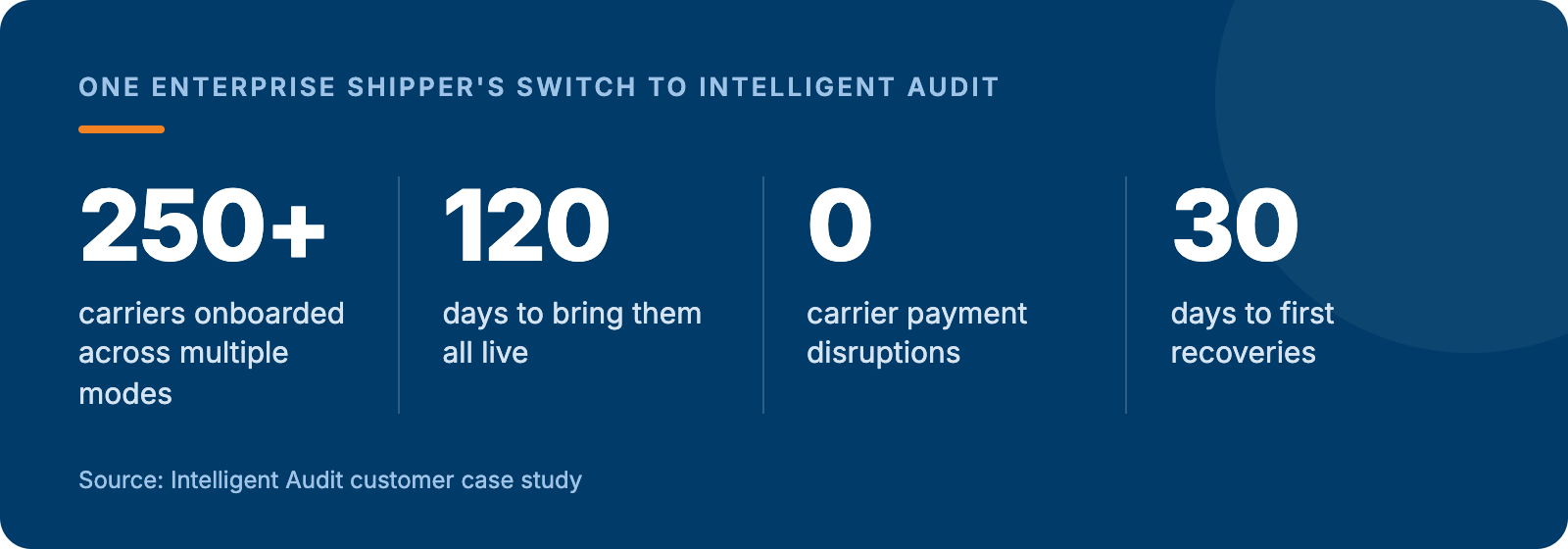
Switching freight audit and payment providers is a planned data-and-setup project, and it’s less risky than most shippers think. With a phased rollout and parallel payment processing, one enterprise shipper moved 250+ carriers onto Intelligent Audit in 120 days with zero disruptions to carrier payments. It found its first recoveries within 30 days.
Plenty of shippers stay with an audit that isn’t working because switching sounds risky. Carriers might go unpaid, invoice history might get lost, and IT might get pulled off other projects. Each of those risks has a known fix.
This guide covers the signs it’s time to switch, what you gain beyond standard audit savings, how a well-run transition works, and the questions to ask before you sign.
Is It Hard to Switch Freight Audit Providers?
It’s a setup project more than anything else, and your provider should handle most of it. The effort depends on four things: how many carriers you use, how many modes you ship, how you receive invoices, and how many systems need to connect.
A parcel-only shipper with a handful of carriers is a small project. A global shipper with hundreds of carriers across LTL, truckload, ocean, and air is a bigger one. That said, the steps are the same, and phasing the rollout by mode or carrier keeps each stage manageable.
Most of the work on your side is gathering what you already have: carrier contracts, rate files, business rules, and GL coding logic. At Intelligent Audit, a dedicated Implementation Project Manager leads every implementation, and our team works directly with your carriers to set up invoice delivery.
Signs It’s Time to Switch Freight Audit Providers
How do you know it’s time to make a change? That largely depends on the value you were promised, what you expect from the provider, and how happy you are with the current partnership. But here are three major signs that we’ve seen from shippers that ultimately moved to Intelligent Audit.
1. Carriers Are Getting Paid Late
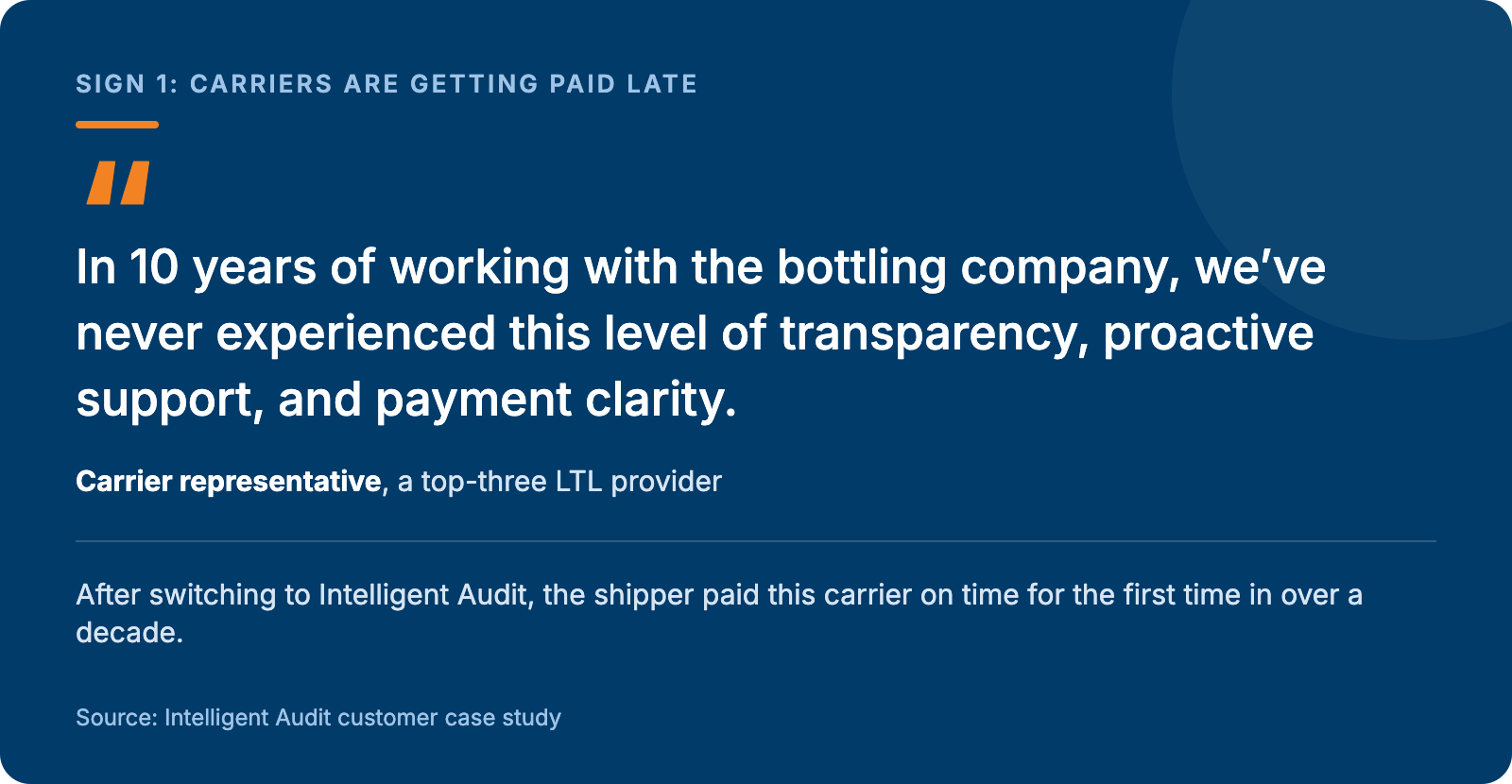
Late payments strain your carrier relationships. A global bottling company came to us after chronic payment delays and poor invoice visibility from its previous freight audit and payment provider put a 10-year carrier partnership at risk. After the switch, the shipper paid that carrier on time for the first time in over a decade and cleared its aging balances.
The carrier noticed. “In 10 years of working with the bottling company, we’ve never experienced this level of transparency, proactive support, and payment clarity,” said a representative of the carrier, a top-three LTL provider.
2. Your Audit Only Checks the Surface
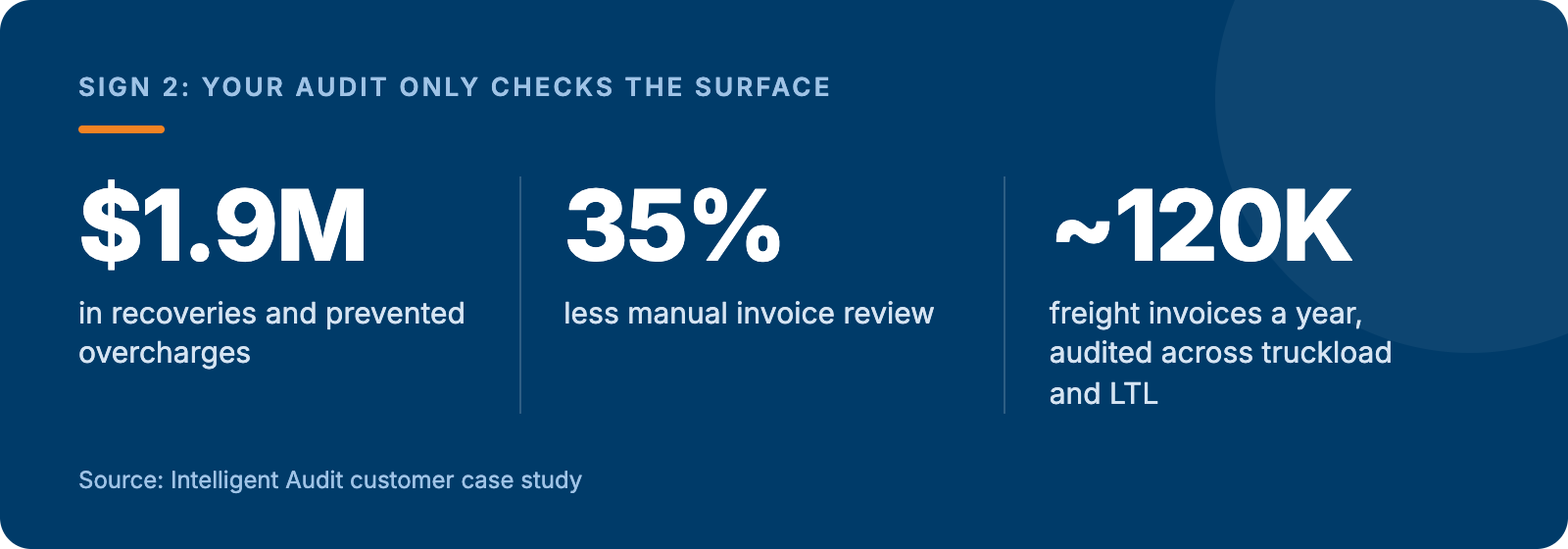
If your audit checks little more than invoice totals, errors are getting paid. One large distributor processing about 120,000 freight invoices a year relied on manual, surface-level reviews, which let contract rate noncompliance, duplicate billing, and accessorial overcharges go undetected. A detailed, multi-layered audit across truckload and LTL delivered $1.9 million in recoveries and prevented overcharges. It also cut manual invoice review by 35%.
3. You Can’t See Your Total Spend
When freight data lives in several ERPs and TMS platforms, nobody gets the full picture. A global manufacturer with 12 business units, nine fiscal entities, SAP, Oracle, and a legacy TMS had no single view of its transportation spend. After consolidating audit and reporting with us, it reached 100% global freight visibility for the first time. Freight cost leakage fell 7.8%, and finance spent 40% less effort on reconciliation.

What You Gain Beyond Standard Audit Savings
Recovering overcharges is just the baseline. The bigger gains come from what a provider helps you unlock with your data after the audit. Customers who move to Intelligent Audit see value in these eight areas:
- Earlier warning on unusual charges: DeepDetectAI flags new charges the moment they deviate from your historical patterns. For one global multi-brand manufacturer, it surfaced $220,000 in new, unplanned spend billed to a non-authorized brokerage account before the charge could compound.
- Broader audit coverage: We audit every mode, including parcel, LTL, truckload, ocean, air, intermodal, and international.
- Cleaner data: We normalize your freight data and apply GL and cost center coding automatically, so finance can trust the numbers. One online furniture and home goods retailer now has 99.58% of its shipments GL-coded.
- Less manual work: At one mid-market retailer, manual invoice validation took 15–20 hours a week. Within weeks of moving to automated freight audit, that time dropped to nearly zero.
- More visibility: More than 750 real-time reports and dashboards show spend, carrier performance, and exceptions across carriers, modes, and business units.
- Recoveries that surface-level checks miss: A detailed audit catches contract rate noncompliance, duplicate invoices, and accessorial errors before you pay.
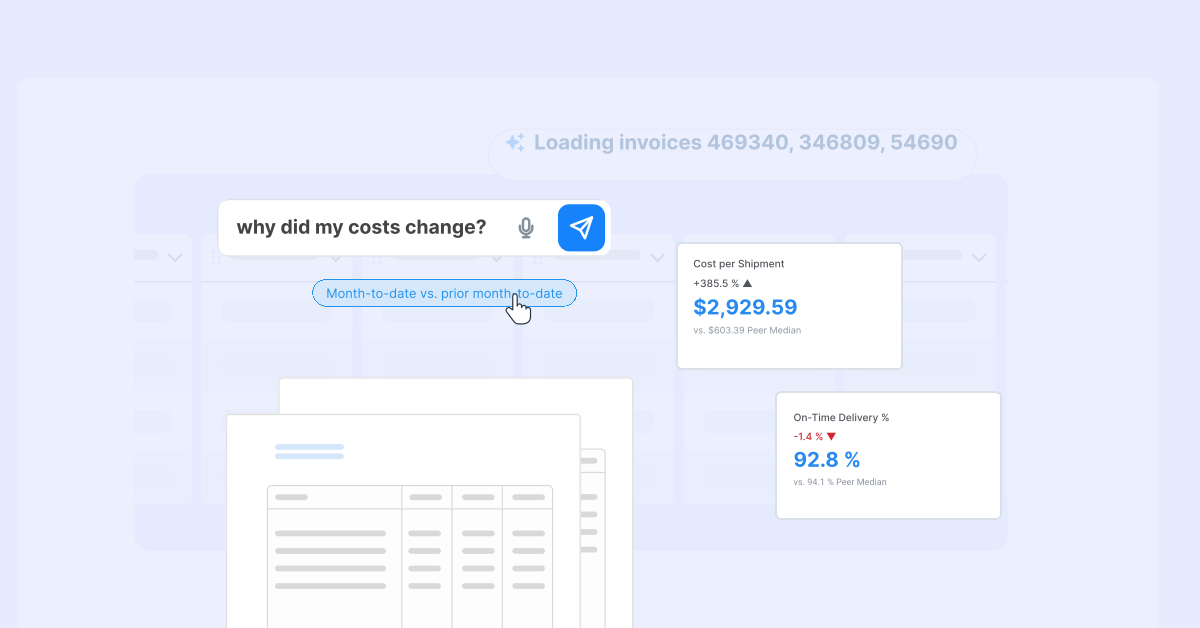
- Answers on demand: Yosi, our always-on transportation superintelligence, lets your team ask what changed, why costs rose, and where to act first.
- Peer benchmarks: PeerIntel, with AI analysis, compares your transportation performance with that of similar shippers.
With Intelligent Audit, you get 30 years of freight invoice experience and a platform we keep improving, with grounded results instead of hype.
How Long Does It Take to Switch Freight Audit Providers?
It depends on your carrier count, modes, invoice formats, and integrations. Value arrives sooner than the full transition, because audit results start as soon as the first carriers go live. At Intelligent Audit, time to value is measured in weeks, not months.
Two reference points:
- Growing parcel shippers on Catalyst: most are up and running within a couple of days of sharing billing center credentials.
- Enterprise, multimodal shippers: one customer onboarded 250+ carriers in 120 days and saw its first recoveries within 30 days.
Questions to Ask Before You Switch
Use these questions to test how a new provider will handle the move:
- Who leads the implementation, and who supports us after go-live?
- Can we phase the rollout by mode, carrier, or region?
- How will you keep carrier payments on schedule during the cutover?
- Who contacts our carriers, and what do you need from us?
- Can you load our invoice history so reporting doesn’t start from zero?
- When will we see the first audit results?
- Which security reports can you share, such as SOC 1 Type II and SOC 2 Type II?
To judge providers and understand the current landscape, read A Higher Standard for Freight Audit and Payment and Bart A. De Muynck’s framework for selecting a freight audit partner.
How Intelligent Audit Handles the Switch
Every implementation follows a structured method led by a dedicated Implementation Project Manager. It covers discovery, carrier onboarding, system integration, contract configuration, business rule setup, testing, reporting configuration, training, and process validation.
After go-live, a dedicated account management team stays with you, with executive escalation paths when you need them. We complete annual SOC 1 Type II and SOC 2 Type II audits, so you know your data is secure. We keep 98% of our customers year after year, so you can feel confident joining shippers like Eaton, Lululemon, Medtronic, Caterpillar, Wayfair, and more.
Frequently Asked Questions
Will My Carriers Notice When I Switch Freight Audit Providers?
They’ll receive new invoice delivery instructions, and our team works with them directly during onboarding. Payments stay on schedule through a phased rollout and parallel payment processing. In one 120-day implementation covering 250+ carriers, there were zero carrier payment disruptions.
Do I Have to Change Carriers or Contracts to Switch Audit Providers?
No. Your carrier contracts stay the same. Your new provider audits invoices against your existing contracted rates and terms.
Can We Switch One Mode or Region at a Time?
Yes. Intelligent Audit can phase an implementation by mode, carrier, milestone, or business priority.
How Much IT Work Does Switching Require?
Your IT team connects the audit platform to your TMS and to your ERP or accounting system through SFTP, EDI, flat files, or APIs. The Implementation Project Manager coordinates the work.
How Soon Will We See Results After Switching?
Results start when the first carriers go live. One enterprise customer found its first recoveries within 30 days.
Ready to Switch?
Start with a discovery call and a free ROI assessment. Let’s get you set up here.
Subscribe for more content!
Stay ahead of the curve in supply chain and logistics technology. Get practical insights on AI-driven automation, real-time visibility, and the tools reshaping how goods move—delivered straight to your inbox.