AI for Transportation Teams: Turning Everyday Use Into Real Results


Most transportation professionals have tried ChatGPT, Copilot, or Claude by now. Fewer can point to any material impact on their teams and/or operations. McKinsey’s 2026 State of AI survey highlights how big that gap is: 80% of respondents said AI made them more productive, but only 37% said it added anything to their company’s EBIT.
Intelligent Audit’s October 14 webinar, Practical AI for Transportation Teams: What to Build, What to Buy, and Where to Start, addressed that gap. CEO Hannah Testani led the conversation with Chief Product Officer Dr. Brian Pollack, one of the laureates of the 2025 Breakthrough Prize in Fundamental Physics for his work on CERN’s CMS experiment, and Chief Operating Officer Paul Finley, who spent years as a shipper before joining Intelligent Audit more than 12 years ago.
The consensus among these experts was that AI only starts paying off when it’s connected to the data and expertise a team already has. A better chatbot for each person won’t get you there. Because Intelligent Audit spent much of 2026 connecting its own business to AI, this panel spoke from experience. Here’s a rundown of everything they shared during the webinar.
Why Individual AI Use Doesn’t Scale
The first reason AI stalls is simple: it’s only as effective as the information and context it’s working from and within. Brian described how most people start. A chat assistant is a strong helper for targeted work, like answering a question or drafting something, but each person must supply the background every time.
“What you don’t want, or at least what’s not scalable, is having every single person on your team do that,” he said. “Continue to dump that into a chat box and hope for the best.”
Each person ends up teaching the AI the business from scratch, and the answers drift from one person to the next. Hannah framed it as the difference between an individual and a team. “It’s very easy for me to go create my own agent,” she said. “It’s hard for that to scale.”
So this approach leads to personal gains only. Brian’s fix is a shared pool of business knowledge that AI can pull from without being told and without needing one-off instructions. With this setup, two coworkers asking the same question get similar responses, and an engineer and an operations lead work from the same numbers and definitions.
Intelligent Audit has made the case for a similar approach with freight audit, where AI is a tool and expertise is the advantage.
What Is an MCP Server?
An MCP server is the unglamorous keystone that makes shared context possible. Brian explained it like this: A basic chatbot is an AI model inside an app, but a connected assistant adds a plugin with two parts. First, skills are written instructions for how an expert would handle a task, such as confirming who the user is and which customer an invoice belongs to before looking it up. Second, the MCP server (short for Model Context Protocol) gives the AI a defined set of tools to call.
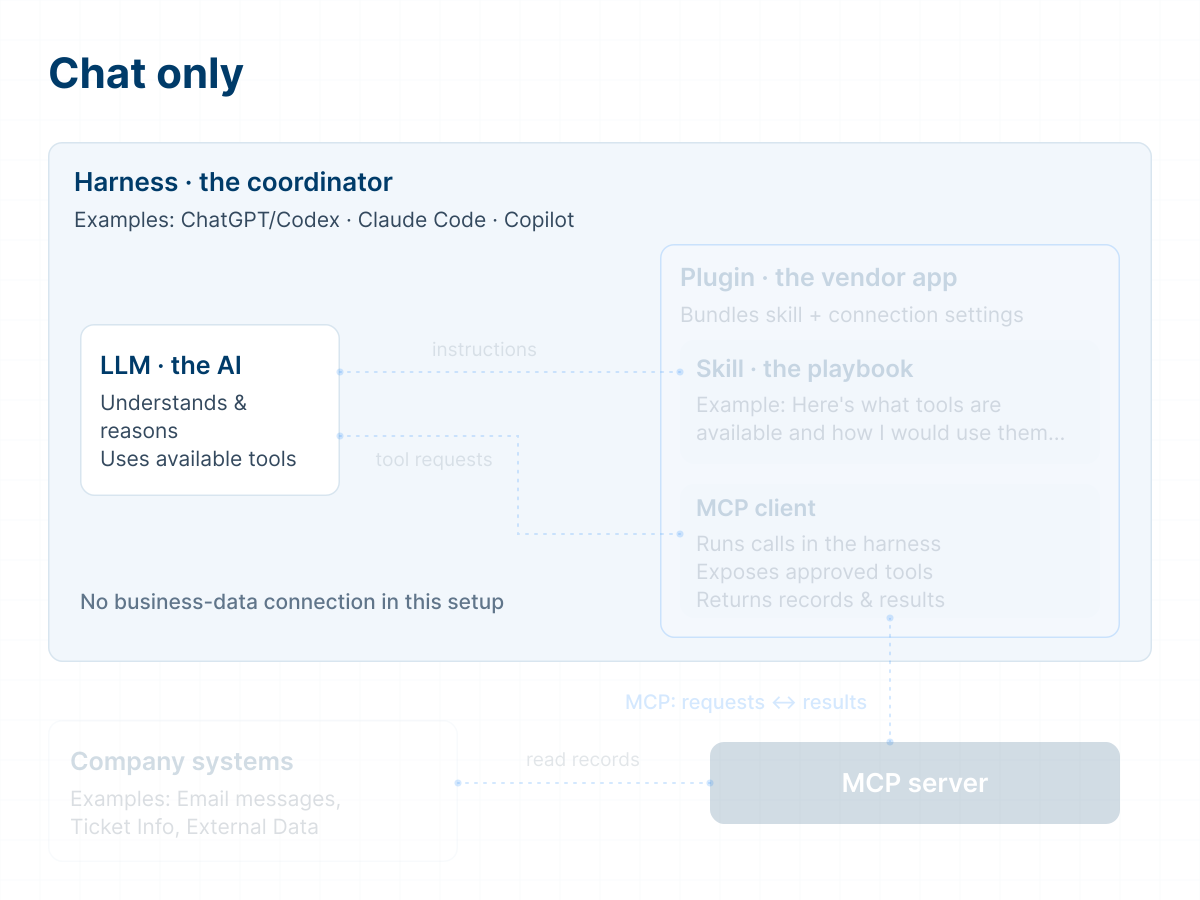
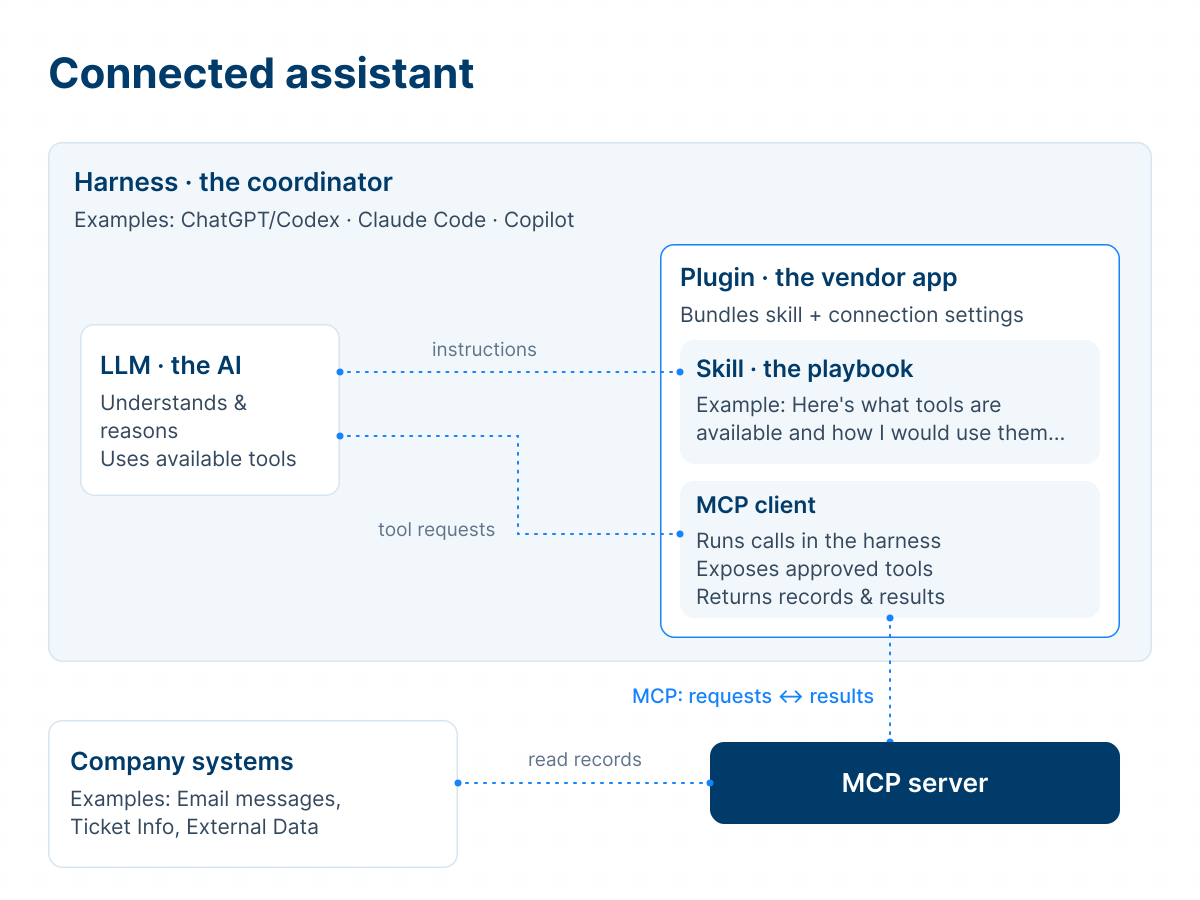
Chat only: the AI can reason and draft, but it only knows what you paste in.
“MCP is basically like an API layer, but specifically for AIs,” he said. “This is for an AI to read, so an AI knows exactly what tools it can use for a given vendor.”
Many software vendors already offer MCP servers, Brian noted, including Outlook, Atlassian, Zoom, and Slack. At Intelligent Audit, Hannah said, that meant connecting the CRM, the Atlassian tools where procedures and customer requests live, and the audit data itself. After that, Brian said, users no longer need to worry about where data sits or whether they loaded it the way a colleague did.
For shippers, Hannah suggested starting with order, warehouse, and transportation management systems, plus freight audit data. Connect those, she said, and “now you’re able to start talking to your data, or better yet, have your data talk to you.”
The caveat is that none of this works on messy data. Hannah said she spent years urging audiences to invest in data governance, because an AI-first future would depend on connected databases.
Why Operations Teams Should Lead on AI
The biggest surprise in Intelligent Audit’s own rollout was who benefited most from it. Hannah said some of the strongest results came from Paul’s operations team (not engineering). Paul admitted he went into the launch with doubts: “I was skeptical that the average business user could actually pull this off.”
“Once you get into it and you start working with it, and you treat it almost like a co-worker, another subject matter expert,” he said, “and you just talk to it like you would talk to any engineer or any other business process owner. You learn pretty quickly the power of these models.”
Paul’s team leans on AI hardest for troubleshooting. For example, a solutions architect lays out what broke and what should have happened, and the AI helps sort out whether the cause is the data or the software. By the time a ticket hits engineering, the investigation is mostly complete. His managers went further and built what Paul calls control towers, which are views of their areas that flag trouble early, before a carrier or customer feels it. One of the first tools, a GL coding troubleshooter, shows where coding rules fall short for any customer, timeframe, and business unit.
“It says, ‘OK, you’re at 95%,’” he explained. “You feel pretty good about it. But then you realize that 5% is causing hours upon hours of manual work for the customer.”
From there, the data points to new rules that could replace that manual work, which gives the team a specific proposal to bring to the customer. (Intelligent Audit has written more about freight GL coding.)
For other transportation teams, the lesson is that the people who know the work should be the ones shaping the tools. Here’s how Paul explained it: “What operational teams can realistically build starts with the work they already understand.” He suggests starting with the first hour of the workday. Someone pulls reports from several systems, checks for carrier updates, and decides which shipments to chase, using knowledge that may never have been written down.
Build vs. Buy: How to Decide on AI Tools
Connected AI makes building inexpensive, but it also creates its own risk. Brian called it the “prototype trap.” AI can produce a working version of almost anything in hours or days. Scaling it, securing it, and handling the edge cases is more complex, and he said it would make little sense for Intelligent Audit to rebuild something a vendor like Zoom already does well.
“Regardless of what AI spits out, it’s not going to be set it and forget it,” he said. “It’s going to be something that we build, and we iterate on it, and then we have to maintain. And if you need to maintain it, you need people that actually know what they’re doing.”
Brian said that each build gets weighed on time, expected AI spend, and the people needed to keep it running, and then leadership signs off on the problems that are worth the total investment. Hannah passed along a rule of thumb from a recent industry conference: if it sets you apart, build it; if you won’t keep pouring money into it to stay best in class, buy it. Shippers face the same trade-off when deciding whether to build AI in-house or rely on a freight audit partner.
The engineer’s job is shifting as well. According to Brian, most engineers aren’t writing much code by hand anymore. AI drafts it, and they review it to ensure it works, scales, and stays secure. Prototypes now show up early enough that stakeholders can react to something real instead of a written plan. Earlier this year, some predicted AI would replace engineers. Hannah said Intelligent Audit’s engineering, product, and data science teams are all thriving instead.
What’s Next: MCP-to-MCP Connections
The next stage takes connected AI beyond a single company. Intelligent Audit customers can see the first step in Yosi™, the company’s conversational AI analyst, named for founder Yosie Lebovich. Brian said Yosi runs on the internal MCP server and is available now to a group of beta customers. It answers questions about invoices, shipments, GL coding rules and spend trends, takes users to the right page in the portal, and runs reports. (Here’s more on what Yosi does.)
Brian said the company also intends to release an external-facing MCP, so customers could reach Intelligent Audit data from inside their own AI tools without opening the portal. The connection could run the other way too, letting Intelligent Audit’s AI clear up unclear shipment details directly with carriers and customers. Hannah described where that leads.
“Once we can have MCP to MCP talking, then we can see right away that there’s some improvement to be done somewhere in the supply chain ecosystem,” she said, “and our MCP can talk to your MCP and say, ‘You likely have a TMS miscoded here, make this change, test it, validate it, and then go implement it.’”
How Transportation Teams Can Start With AI
Hannah acknowledged that not every team has executive backing for a full MCP build. Even so, connecting AI tools to databases helps at the individual level, as long as people in the same role use them the same way. Paul’s advice was to build a business case for leadership and not be intimidated, because the tools change so quickly that “you’re never that far behind.” Brian told attendees to keep pressing engineering for the connections they need: “Tell them, ‘I need my AI to access this data.’”
Hannah has given related advice before, sharing with SupplyChainBrain that companies should start with small, repeatable tasks and build wins team by team. This webinar added what makes those wins last: data and context the whole team shares. For more on where the industry stands, read AI Is Moving Forward. How Can Transportation Teams Move With It?
Watch the full webinar on demand, or get started with Intelligent Audit to put connected AI to work on your transportation data.
Subscribe for more content!
Stay ahead of the curve in supply chain and logistics technology. Get practical insights on AI-driven automation, real-time visibility, and the tools reshaping how goods move—delivered straight to your inbox.